
Is the Kurobe Gorge Railway worth the detour? It’s the question every Tokyo-based traveller asks before they commit a full day of their itinerary to a sightseeing train that runs along a 20km strip of forest in north-east Toyama. The short answer is yes, with caveats. The longer answer involves a bridge collapse, a folk-tale about people-eating rocks, and one of the deepest V-shaped gorges in Japan.
First, the disambiguation that catches everyone out: this is not the Tateyama-Kurobe Alpine Route. The two routes share the Kurobe valley name, the same general river, and even the same dam in the background of the marketing photos. They are completely different trips. The Alpine Route runs east-west through the high mountains via cable cars, ropeways and a tunnel-trolley bus; you reach it from Toyama City or Omachi. The Kurobe Gorge Railway runs along the lower river from Unazuki Onsen, on a vintage 762mm narrow-gauge line that was originally built in the 1920s to haul cement and workers up to the hydroelectric construction sites. Same valley, two completely separate experiences. If a single guide tries to tell you they are the same thing, that guide is wrong.
In This Article
- What the Toroko-densha actually is
- The bridge collapse and what is open in 2026
- Getting to Unazuki: the bit nobody explains properly
- By car
- Carriages: which class to actually book
- Futsu (普通客車): the standard open-sided car
- Relax (リラックス客車): enclosed, padded, +¥600
- Special and panorama cars
- Booking, timetables, and how busy it gets
- Fares (full-line, when service is restored)
- Which side of the train to sit on
- Stop by stop, going in
- Unazuki to Kuronagi (km 0–6.5, about 25 minutes)
- Kuronagi (km 6.5)
- Kuronagi to Kanetsuri (km 6.5–14.3, about 30 minutes more)
- Kanetsuri (km 14.3)
- Kanetsuri to Keyakidaira (km 14.3–20.1, about 25 minutes more)
- Keyakidaira (km 20.1, terminus)
- The four walks from Keyakidaira
- Sarutobikyo Gorge (10–15 minutes one way)
- The Okukane Bridge and Hitokui-iwa (20–30 minutes round trip)
- Foot bath at the river (5 minutes from station)
- The further onsen: Babadani, Meiken, and Sobadani
- Unazuki Onsen as the base
- Where to stay in Unazuki
- Autumn-colour timing: the only week that matters
- Other seasons
- Photography spots
- Food: the toroko bento and what else to eat
- The Kurobe Dam connection: a separate trip entirely
- The brand-new Canyon Route, and what it changes
- What to combine the trip with
- Practical answers to the questions everyone asks
- Is it accessible?
- Can I bring luggage?
- Is it cold?
- Wet weather?
- How long should I plan?
- Cash or card?
- One small detail to close on
What the Toroko-densha actually is
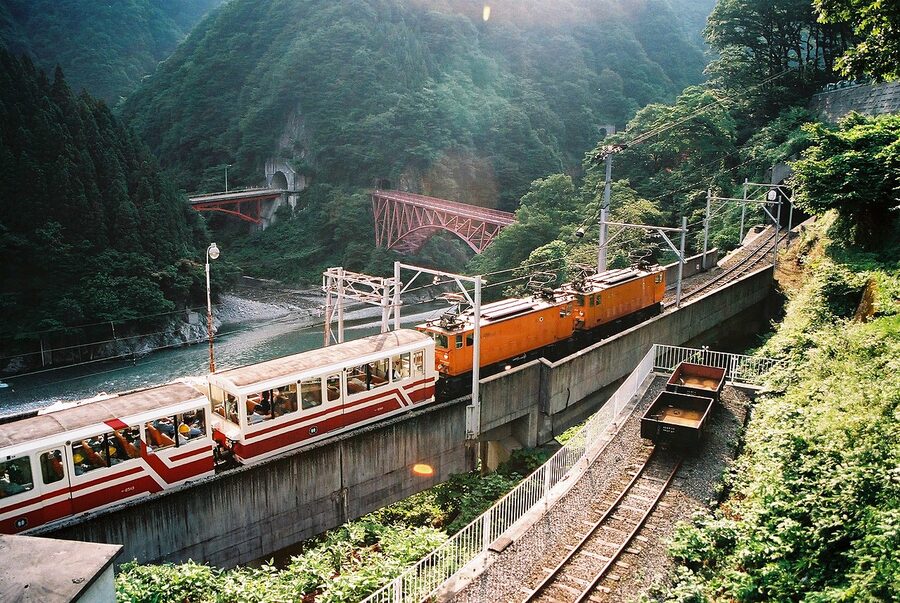
Locals call the train the toroko-densha. Toroko is a Japanese loan from the English “truck”, referring to the small flatbed cars used in mining and dam construction; densha is “electric train”. The name has stuck since the line carried passengers as guests of the construction company, well before regular passenger service started in 1953. The official corporate name is Kurobe Gorge Railway, often shortened to Kurotetsu, and the company is still a wholly-owned subsidiary of Kansai Electric Power. Every ticket you buy is, in some small way, paying back the construction loan on a dam complex that helped power post-war Osaka.
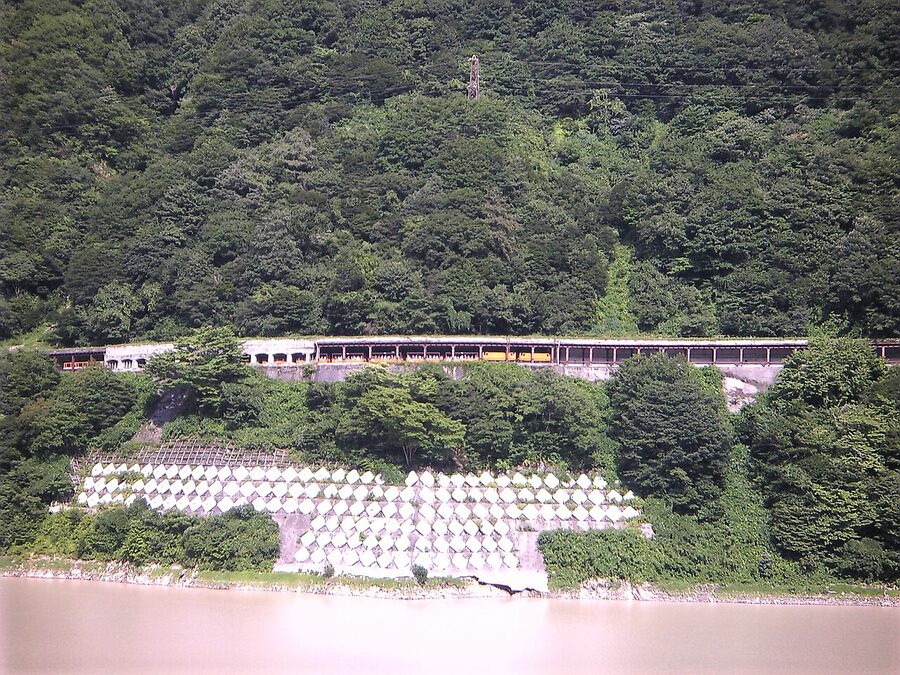
The line runs 20.1km along the western bank of the Kurobe River from Unazuki Station to Keyakidaira Station, climbing about 375m over that distance. The route crosses 21 bridges and tunnels through 41 tunnels, depending on how you count the snow-shed sections. A one-way trip, when the full line is operating, takes about 80 minutes. The trains are tiny, the carriages are open-sided, and the engineering is significantly older than most riders realise. Sections of rail are only 10 metres long instead of the more standard welded long sections, which is why the ride has so many audible joint clacks. A team of just three inspectors walks the whole line on foot every month, looking for any rail variance over 6mm.
The bridge collapse and what is open in 2026
You need to know this before you book anything. On 1 January 2024 the Noto Peninsula earthquake damaged a bridge between Nekomata and Kanetsuri stations. As of writing in spring 2026, trains are running only as far as Nekomata, a temporary terminus station that is normally closed to public passengers but has been opened with a special platform during the works. The full line through Kanetsuri to Keyakidaira is closed at least until 30 September 2026, with the operator saying it will announce in early July whether full-line service can resume from October.
The practical effect: a round trip to Nekomata costs ¥2,820 for adults, takes about two hours, and gets you the gorge scenery and a short stretch on the temporary platform. You do not get to Kanetsuri’s switchback, the Mannen Yuki snow bank, or the Keyakidaira terminus walks (Sarutobikyo, the Okukane Bridge, the Hitokui Iwa rock-tunnel path). Those are the most-photographed sights on the railway, and they are why a lot of foreign visitors choose the trip in the first place. Several recent reviews on travel forums point out, fairly, that paying ¥2,820 for an out-and-back to Nekomata is a much weaker offer than the full ¥3,960 round trip to Keyakidaira would have been. If you have already factored in the day from Tokyo or Kanazawa, the train ride alongside the gorge in autumn is still genuinely beautiful. If you only care about the famous photo spots, wait until full service resumes.
The rest of this guide assumes the full line is operating, with notes flagged where the 2026 closure changes the practical advice.
Getting to Unazuki: the bit nobody explains properly
The single biggest source of confusion is the station naming. There are three “Unazuki” stations within walking distance of each other, and they are not the same thing.
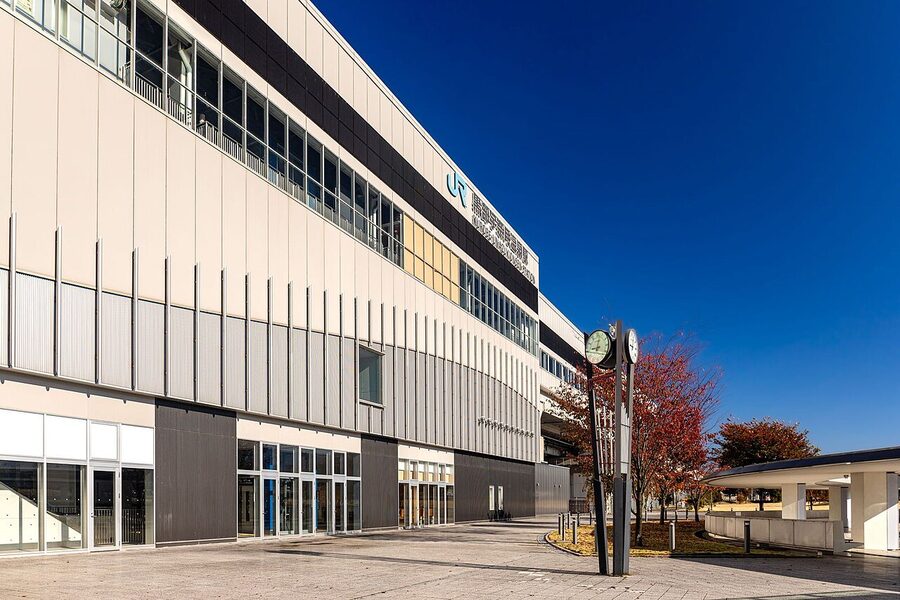
- Kurobe-Unazuki Onsen Station is the JR Hokuriku Shinkansen stop. This is where you arrive from Tokyo, Kanazawa, or Toyama City. It sits about 6km west of the onsen town itself, in farmland.
- Shin-Kurobe Station is the Toyama Chiho Railway (Toyama-chitetsu) station immediately next door to the Shinkansen station, with a covered passage between them. This is your transfer station.
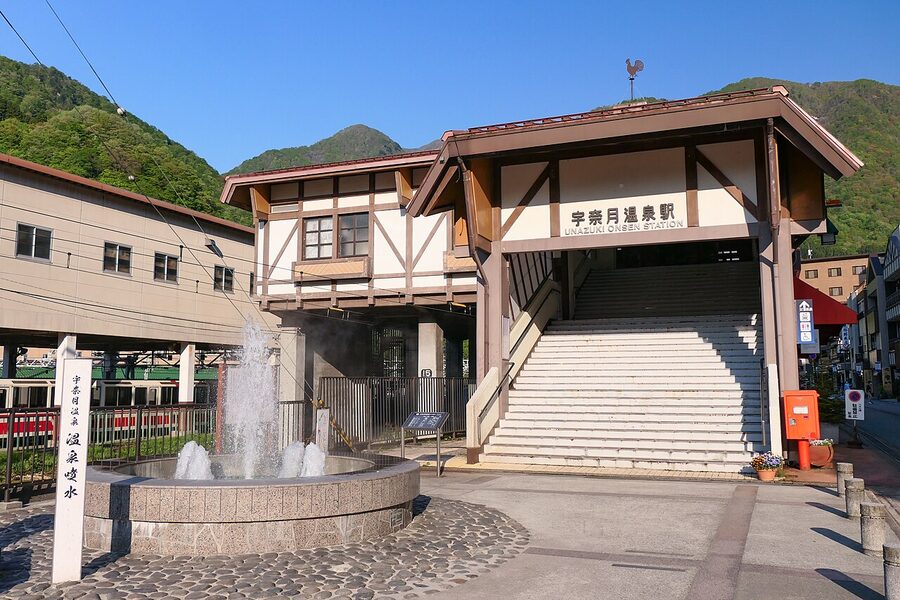
- Unazuki Onsen Station is the Toyama-chitetsu terminus, in the middle of the onsen town. From here it is a five-minute walk to the toroko ticket office.
From Tokyo, the practical route is JR Hokuriku Shinkansen to Kurobe-Unazuki Onsen (about 2 hours 30 minutes, ¥12,000 one way, one train per hour, covered by the JR Pass), then transfer at Shin-Kurobe to the Toyama-chitetsu Honsen for Unazuki Onsen Station (25 minutes, ¥740, one or two trains per hour, not covered by the JR Pass). From Osaka or Kyoto, take the JR Thunderbird limited express to Tsuruga, transfer to the Hokuriku Shinkansen, and you’ll arrive at Kurobe-Unazuki Onsen after about three hours total at a cost of around ¥11,000-12,000. From Kanazawa it is just under an hour on the Shinkansen.
The toroko trains depart from a fourth station, the privately-operated Unazuki Station of the Kurobe Gorge Railway, which is a five-minute walk from Unazuki Onsen Station along the main onsen-town road. You cannot ride straight through from Toyama Chiho rail to Kurotetsu; the company is separate, the platforms are separate, and you need to buy a separate ticket. Our access guide covers the wider region’s rail logic if you’re combining this trip with other Japan Alps stops.
By car
The Kurobe IC exit on the Hokuriku Expressway is about 20 minutes from Unazuki Station. There is a paid car park in front of the station with around 350 spaces, but it fills early in autumn weekends. You will need to be at the ticket office at least 20 minutes before departure for boarding.
Carriages: which class to actually book
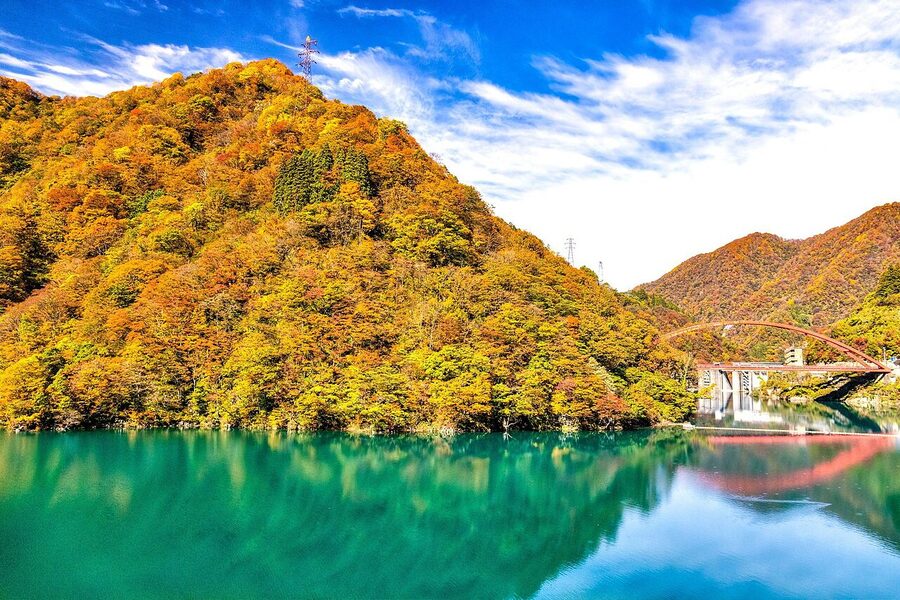
There are four passenger-car classes on the line, and the booking website doesn’t always make the differences obvious. Pick the one that matches your weather and your photography plans, not the one that’s cheapest.
Futsu (普通客車): the standard open-sided car
The default. Open sides, fixed wooden bench seats arranged crosswise with no backrests, four people per row. The ticket price is the base fare with no upgrade. This is the carriage that defines the toroko experience: the wind on your face, the river noise, no glass between you and the cliffs. It’s the right choice from late spring through early autumn when the air is warm and you want the photographs without window glare. It is also genuinely cold once you go higher into the gorge, even in midsummer, so a fleece in your bag is non-negotiable.
Relax (リラックス客車): enclosed, padded, +¥600
Glass windows that slide open if you want them open, reversible cross-seats with backrests, three abreast instead of four. The fare is the same as futsu plus a flat ¥600 carriage upgrade regardless of distance. This is what you book in late October and November when the wind on your face stops being romantic and starts being painful. Some Relax cars have a wider barrier-free door for wheelchairs. Worth the ¥600 in autumn and shoulder-season; pointless in summer.
Special and panorama cars
The 2800-class lounge car and the 3000-class panoramic observation car are also enclosed, with even more comfortable seating and broader windows. They run on selected services rather than every train. If you are particular about photography you may prefer the simpler Relax car: the panorama windows have more glass curvature and reflections, which can be a problem at dusk. Check the operator’s seat-allocation diagrams when you book; the official site shows real-time availability per carriage type.
Booking, timetables, and how busy it gets
The season runs from mid-April to late November. Outside of those dates the railway closes entirely; snow loading on the line is too high to operate safely, and several stations are buried for the winter. Within the season the timetable is dense at peak times: at the busiest hours up to five trains an hour leave Unazuki, with the first usually around 08:00 and the last around 15:00. From the upper terminus the last return service typically leaves in the late afternoon, with the exact times varying by season.
Tickets can be bought on the day at Unazuki Station, by phone, or online at the official reservation site (torokko-yoyaku.com), which has English. Same-day tickets exist but at peak weekends and through the autumn-colour fortnight you should reserve in advance: at peak times the cheaper services sell out by 09:00 the day before. Group reservations from inbound tour operators eat large blocks of seats. If you only have one shot at the trip, book a fortnight ahead.
A note on the JR Pass: the Kurobe Gorge Railway is privately operated, so the JR Pass does not cover it. In 2026 a 10% same-day ticket discount applies to holders of several JR passes (Hokuriku Arch Pass, Hokuriku Area Pass, Kansai-Hokuriku Area Pass, JR West All Area Pass, Takayama-Hokuriku Tourist Pass, Alpine-Takayama-Matsumoto Area Tourist Pass, Hokuriku Shinkansen one-way ticket). The discount excludes the ¥600 Relax-car upgrade.
Fares (full-line, when service is restored)
Adults pay around ¥1,980 one way Unazuki to Keyakidaira and ¥3,960 return; the Relax-car upgrade is ¥600 flat regardless of distance. Children’s tickets are roughly half. With the line currently terminating at Nekomata, the round-trip fare is ¥2,820 adult and ¥1,420 child. Round-trip tickets do not allow you to alight at intermediate stations: if you want to break the journey at, say, Kanetsuri to use the riverside bath, you have to buy a single to Kanetsuri and a fresh single onwards, planning your return train carefully.
Which side of the train to sit on
This is the most-asked question on travel forums and the answer is unequivocal: sit on the right side heading into the gorge. The river is on your right going up to Keyakidaira, the most dramatic cliffs are on your right, the bright-red Shin-Yamabiko Bridge is best viewed from the right. Coming back, the river is then on your left, but most people prefer the inbound right-side seats and accept that the return view is less spectacular. Seats are unreserved within each carriage, so getting a right-hand seat means being early to the platform, even with a reservation. Twenty minutes ahead is the right amount of buffer.
Stop by stop, going in
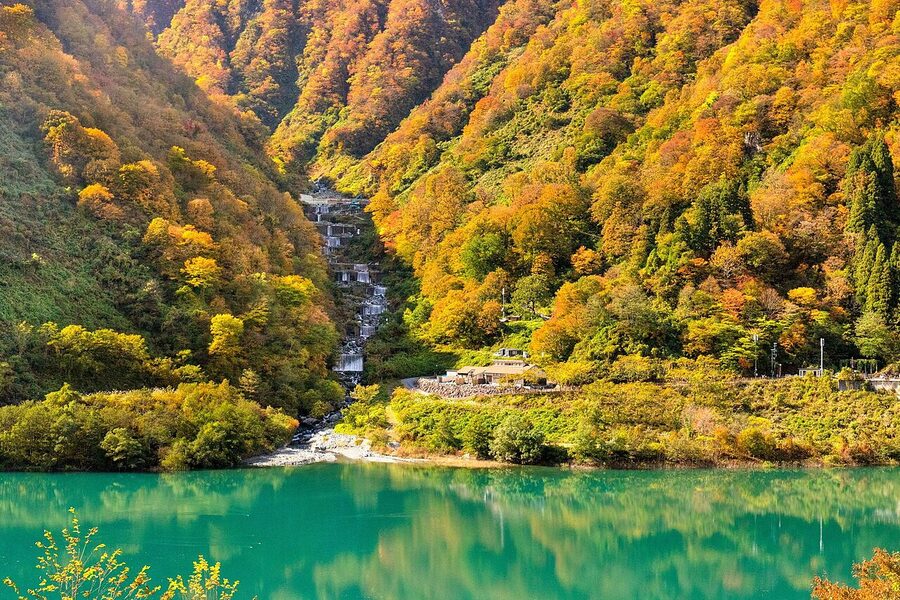
The full line has ten stations; only four are passenger stops in normal operation: Unazuki, Kuronagi, Kanetsuri, and Keyakidaira. The others are crew or maintenance stops where the train will pass without opening doors.
Unazuki to Kuronagi (km 0–6.5, about 25 minutes)
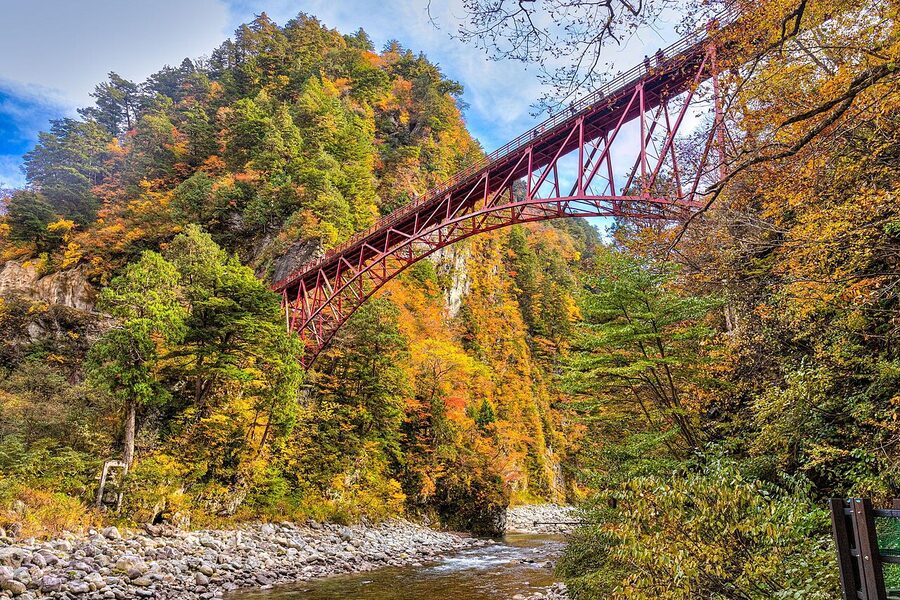
The train pulls out of Unazuki Station along a curve and immediately crosses the bright-red Shin-Yamabiko Bridge, which sits about 40m above the river. The bridge gets its name from the way the train wheels echo through the onsen town below. From the right-hand side, look down for your first proper view of the river. Almost immediately the train passes Unazuki Lake, the artificial reservoir formed when Unazuki Dam was completed in 2001. There is a small “monkey bridge” suspended across the lake, originally built so that the resident macaque troop could cross to the opposite bank without dropping into the water, although it has fallen into disrepair since the troop’s habits changed.
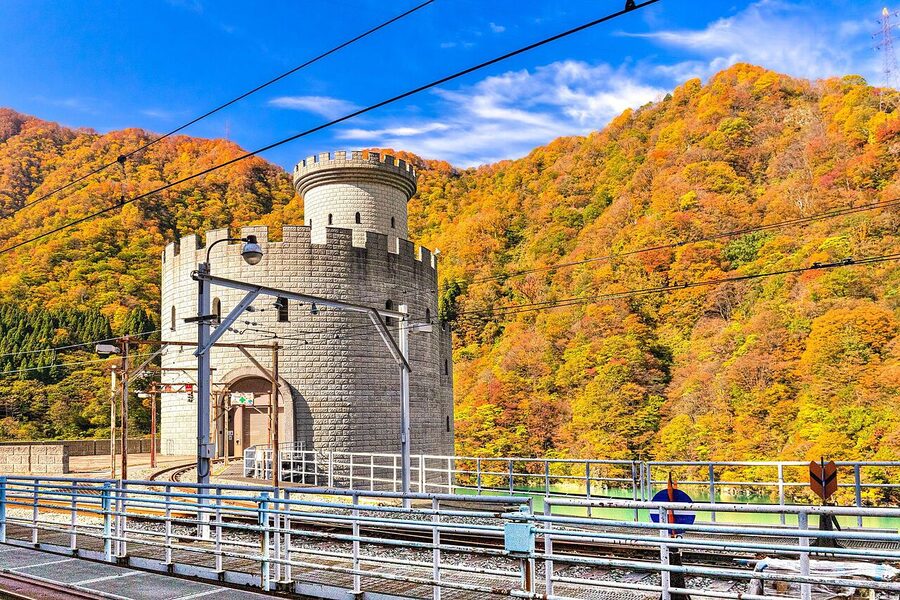
You then pass Shin-Yanagigawara Power Station, an early-1990s replacement for an older plant that was submerged when the dam was built. The new station is built to look like a small European castle, all pale stone and turrets, which makes it one of the more surreal sights on the line. After Yanagibashi (a non-stop station) you reach Kuronagi.
Kuronagi (km 6.5)
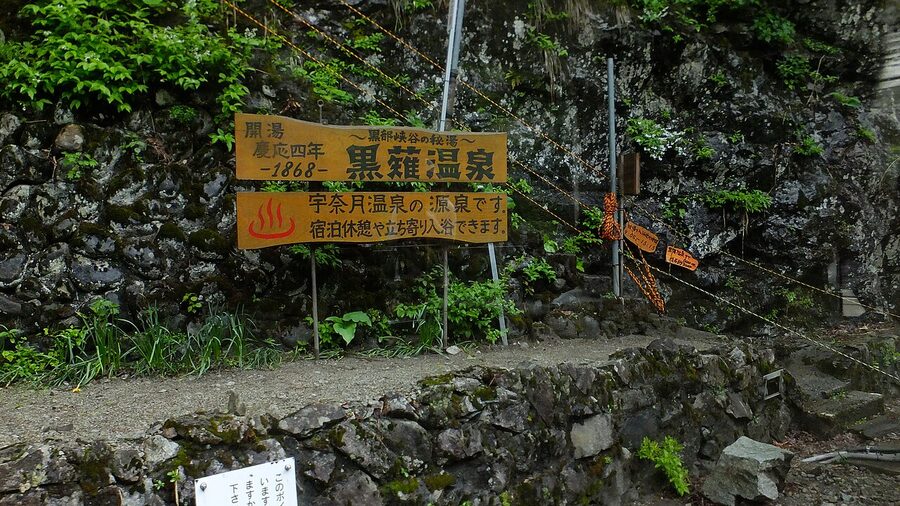
A small, cliffside platform perched above the confluence of the Kuronagi and Kurobe rivers. Most through-passengers do not get off here; the brief stop is an opportunity to peer up at the blue Atobiki Bridge, a 60m-tall span just upstream that gets its name (literally “back-away bridge”) from the steep walls said to make even mountaineers retreat. If you do get off, you are committing to a 20-minute walk along a narrow forest trail to Kuronagi Onsen Ryokan, the oldest hot spring in the gorge, discovered in 1645, and one of the most atmospheric mixed-bath river-edge baths in central Japan.
The ryokan opens its bath for daytime visitors (¥800 admission, hours roughly 09:00 to 15:15, closed late November to early May). The flagship is the mixed-gender riverside rotenburo, with a separate women’s outdoor bath and indoor baths. Onsen culture in this part of Japan is closer to mountain bathing than spa culture; tattoos are usually fine, towels are optional, and the etiquette is the rinse-and-soak rule that applies everywhere. Our wider onsen guide covers the regional onsen geography in more detail.
Kuronagi to Kanetsuri (km 6.5–14.3, about 30 minutes more)
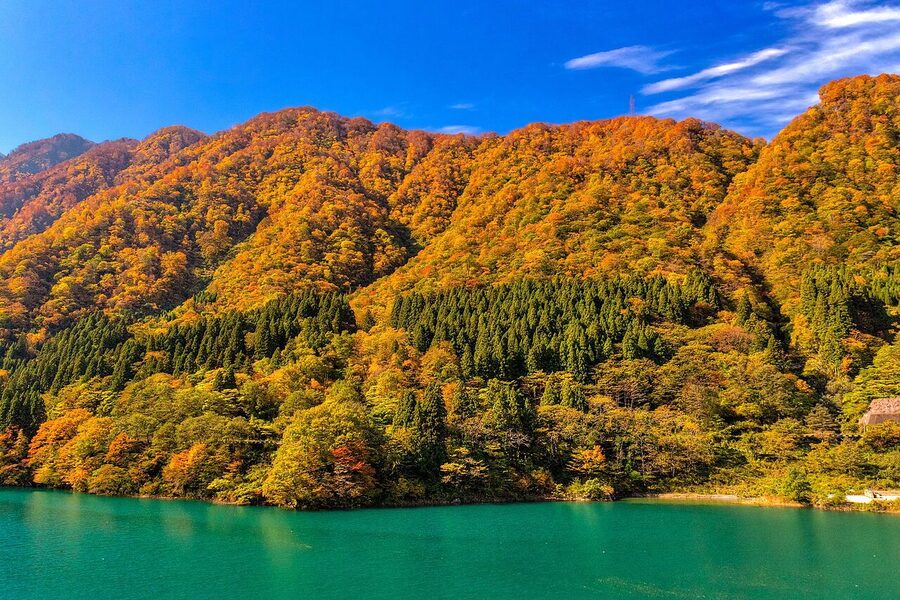
This is the section the photographs are made of. The line tunnels in and out of the cliff face, crosses the river, ducks back under the rock. Past Sasadaira (a flag stop served only April-May), the train passes Dashidaira Dam and a section where six rocky peaks (the Dashi-roku-ho) emerge from a quiet basin, often described as looking like a sumi-e ink painting. Just before Nekomata Station, on the right, you see the Nezumi-gaeshi-no-iwakabe, a 200m sheer cliff said to be so steep that even a mouse pursued by a cat would have to turn back: the literal name is “the rat-turning rock face”. This is the section the gorge is most known for, geologically.
Nekomata itself is normally a freight-only stop; it has been opened to passengers for the duration of the Noto-quake bridge works, with a temporary photo spot themed around its name (a “rat being chased by a rat being chased” composition that families seem to enjoy).
Kanetsuri (km 14.3)
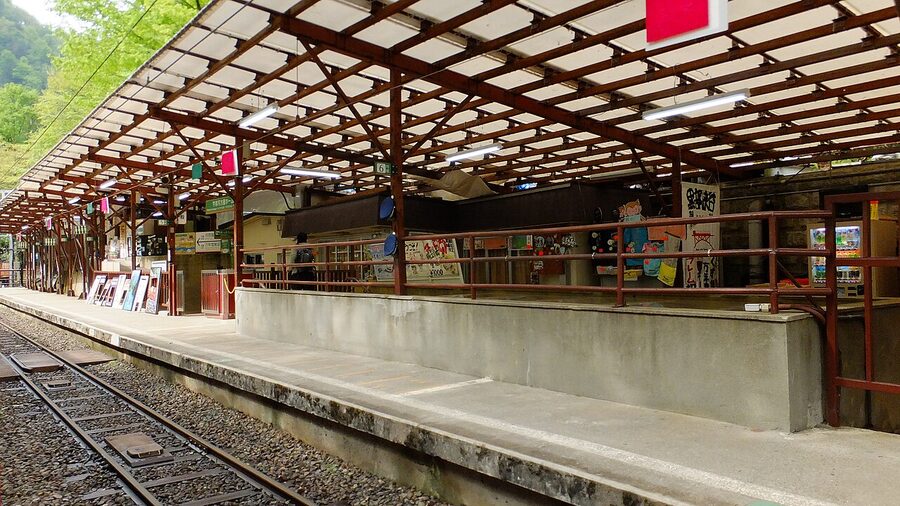
The first really developed intermediate station. A paved path leads from the platform past a food stand and a small cluster of ryokan down to the riverbed. Kanetsuri is one of the only places in Japan where a working railway uses a switchback to reverse direction in tight terrain: the cliffs on either side are too steep for trains to pass each other normally, so up- and down-trains use a short reverse-into-siding manoeuvre that train-spotters travel out specifically to see. It takes about three minutes to watch a switchback in action, and the operator usually announces it on the carriage speakers.
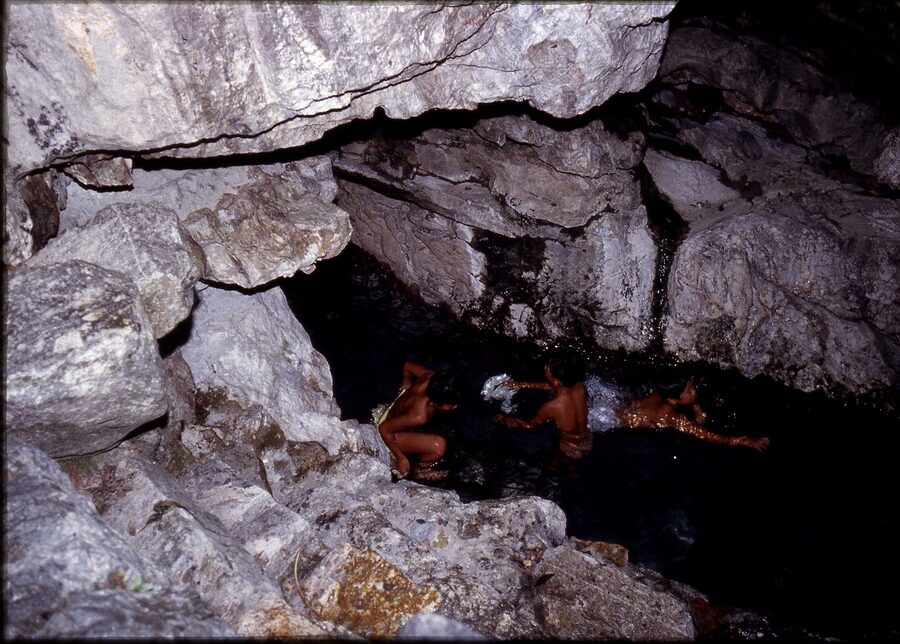
The riverbed has a stone-lined hot-spring pool fed by water that bubbles up directly through the rocks. There are no walls and no facilities; you bathe in full view of every passing train. Most visitors enjoy it as a foot bath rather than a full soak. On the same path, an observation deck looks at the Mannen Yuki (literally “ten-thousand-year snow”), a semi-permanent snow bank piled by avalanches that often survives an entire summer and into the next winter. Best viewed from May through early summer when it is still substantial.
For an overnight stay at Kanetsuri, the small Kanetsuri Bizansou sits beside the platform with rooms looking out at the Mannen Yuki and the passing trains. Light meals are served. It’s the only place on the line you can wake up at trackside.
Kanetsuri to Keyakidaira (km 14.3–20.1, about 25 minutes more)
The final section is the highest and the steepest. The line emerges from a long tunnel at the river’s deepest narrow gorge before pulling into Keyakidaira at about 600m elevation. The temperature drop from Unazuki is noticeable: 5°C cooler is normal in summer, more in autumn.
Keyakidaira (km 20.1, terminus)
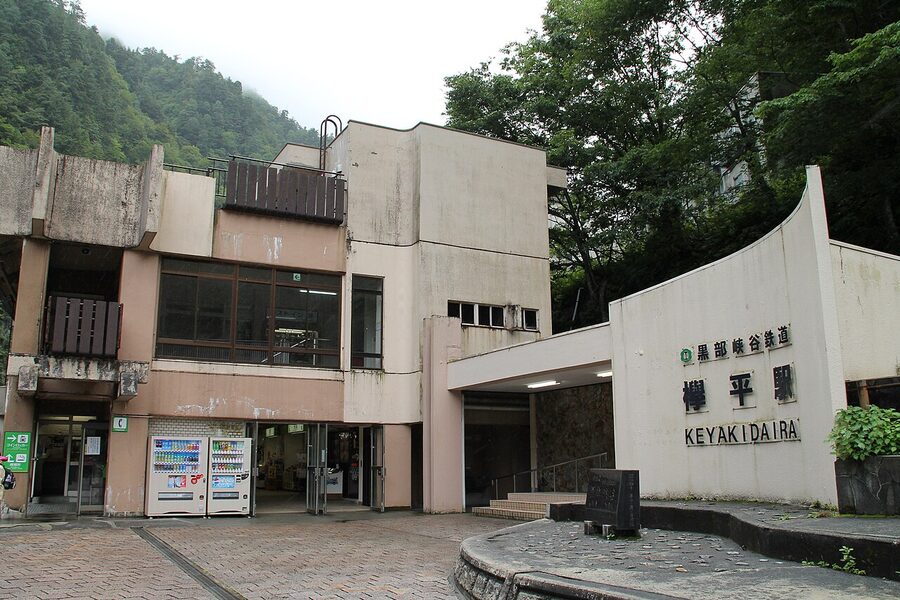
The terminus, where the Babadani River joins the Kurobe River. The station has a rooftop observation deck, an information centre, a single cafe, and a souvenir shop. Plan two hours minimum here if you want to do the walks; three hours if you want to add a bath.
The four walks from Keyakidaira
Keyakidaira is where the train ends but the gorge keeps going. Most visitors take 90 minutes to two hours of light walking from the station; longer if you continue up to the further onsen.
Sarutobikyo Gorge (10–15 minutes one way)
The “jumping monkey gorge”, named for being narrow enough that monkeys reportedly leap across. It’s the headline geological sight at Keyakidaira: the river funnels into a fissure that is just a few metres wide, with sheer rock walls plunging straight to the water. A short riverside trail with a railing leads to an observation deck. It is designated both a Special Natural Monument and a Special Place of Scenic Beauty by the central government, the highest dual designation a natural feature can hold in Japan. (Note: at the time of writing the Sarutobikyo trail itself is closed for path repairs, although the observation deck remains accessible. Check the visitor centre on arrival.)
The Okukane Bridge and Hitokui-iwa (20–30 minutes round trip)
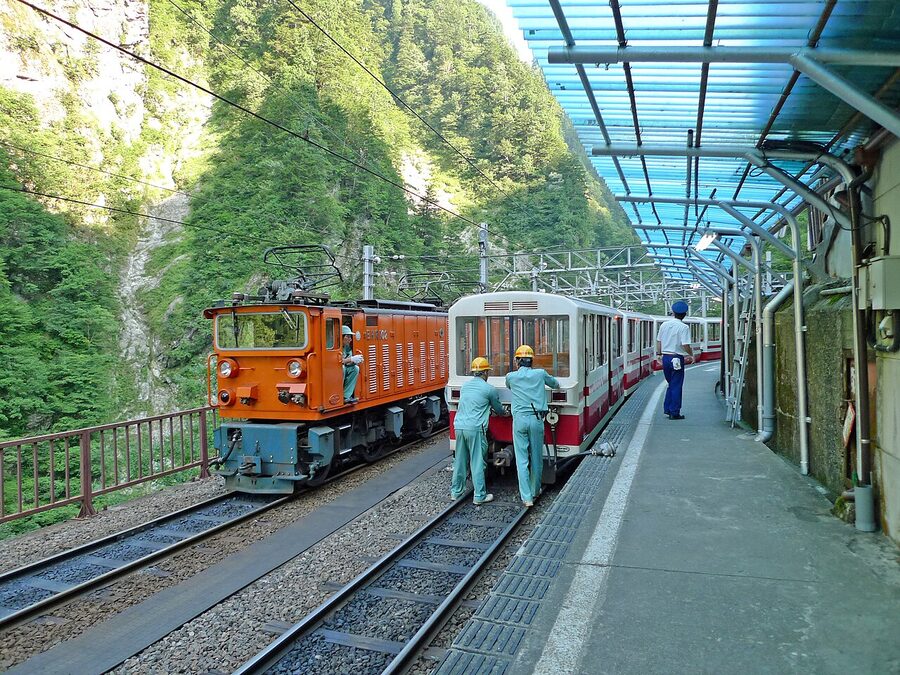
From the station, descend the steps and cross the 34m-tall red Okukane Bridge. On the far side the path is cut into the cliff face under a rock overhang that curves out above the trail like a stone mouth. This is Hitokui-iwa, literally “people-eating rock”. It takes about a minute to walk through the section, and the photo every visitor takes is the one looking up at the curving rock from inside it. Don’t linger directly under: there is occasional small rockfall, which is why the path is reinforced with steel mesh in places.
Foot bath at the river (5 minutes from station)
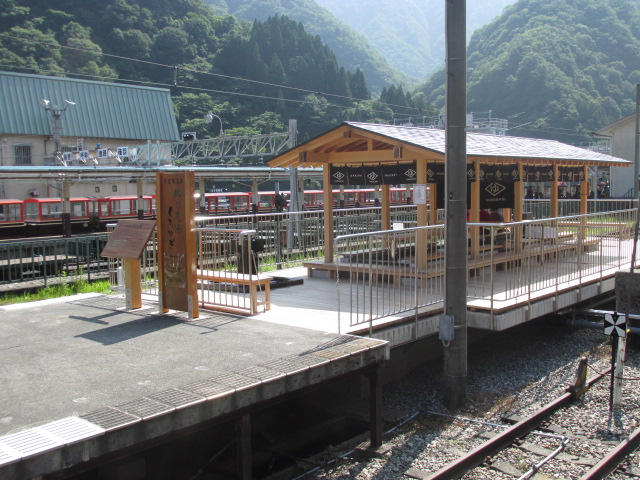
A free public ashiyu (foot bath) sits on a riverside platform under the Okukane Bridge, seating about a dozen people on a covered wooden bench. The water is hot enough to feel rather than just warm. Hours are roughly 09:00 to 15:00, closed December to late May. Take a small towel; there are no provisions for drying.
The further onsen: Babadani, Meiken, and Sobadani
Three named onsen sit beyond Keyakidaira along the trail past Hitokui-iwa.
- Keyakidaira-onsen Sarutobi-sansou sits five minutes from the station, with a separated outdoor bath surrounded by old-growth forest. Day-use bathing and food (mountain vegetables and grilled river fish) are both available.
- Meiken Onsen is a 15-minute walk from Keyakidaira along the gorge, sitting on a cliffside above the Babadani River. The outdoor bath looks down over the gorge with a small waterfall in the distance. The dinner menu is sansai-ryori, mountain-vegetable cuisine.
- Sobadani (Babadani) Onsen is a 60-minute uphill walk into the deeper gorge, with a single ryokan and an unusually open river-edge rotenburo. Beyond the bath, you can dig your own pool in the riverbed where a hot stream meets the cold river: free, public, and entirely up to your own care.
None of the three are accessible from the train when the line terminates at Nekomata. Even when the line is open they require time and decent footwear; budget at least four hours total at Keyakidaira if you intend to bathe at Meiken or Sobadani and still get the last train back.
Unazuki Onsen as the base
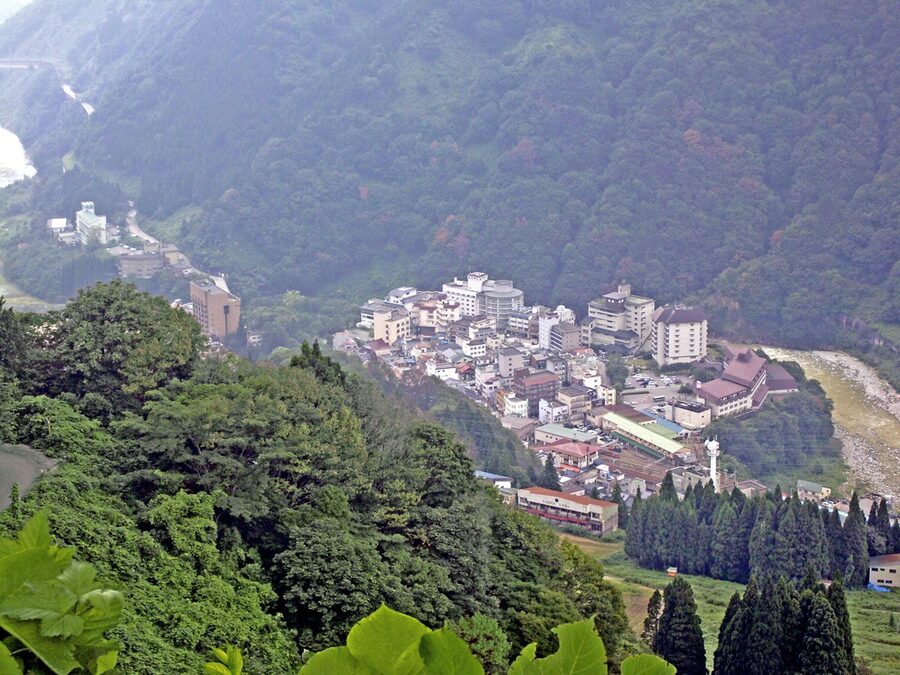
Unazuki Onsen is one of the largest hot-spring towns in Toyama, and it exists almost entirely because of the railway. The town opened as an onsen in 1923 when piping was laid to bring water from the upper gorge; before then there was no settlement here at all. The water arrives at the source at around 90°C, weakly alkaline and almost transparent. Locally it is sold as “the most transparent onsen water in Japan”, which is marketing more than chemistry, but the water is genuinely fine on the skin and easier on a fresh travel sunburn than the more sulphurous waters at Shirahone or Okuhida.
Plan to either stay overnight or build in two hours of bathing time. The town is too small to fill a full extra day, but pairing one toroko ride with one overnight onsen stay gives the trip a satisfying shape. You can add a second day for a slow morning walk and a stop at the small Selene Museum of Art (¥620, focused on contemporary Japanese painters whose subject is the gorge) and the free Kurobe River Electric Memorial Hall on the construction history.
Where to stay in Unazuki
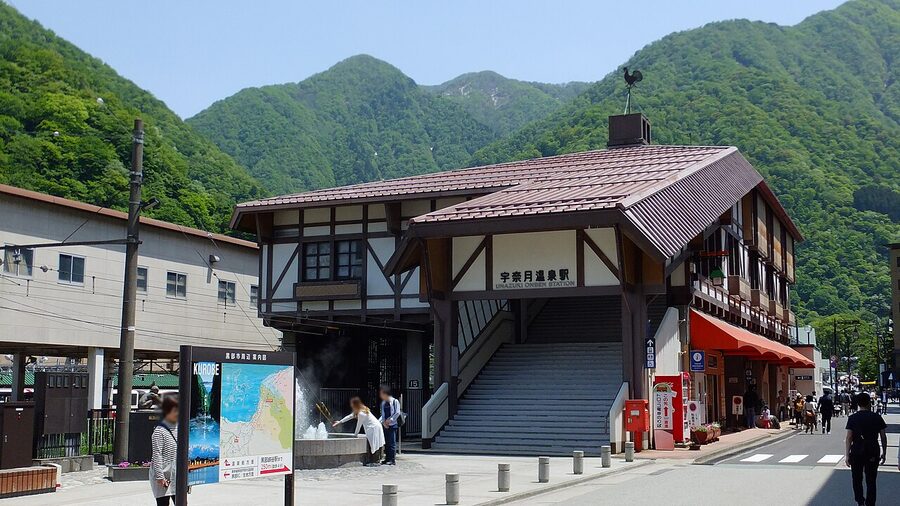
Two ryokan stand out at the upper end of the market, and a handful of mid-range hotels cover the rest of the town:
- Unazuki Suginoi Hotel Yamanoha sits high on the southern hillside with a top-floor open-air bath looking straight up the gorge. The kaiseki dinner is reliable, and the sister-property bath day-pass gives access to a second hotel’s facilities. Book on Booking.com.
- Entaijiso (延対寺荘) is the larger of the two old-line ryokan, with a long history (the building dates from the 1930s, several times rebuilt). Tatami rooms with river-facing balconies, a substantial communal bath, and a kaiseki menu strong on Toyama Bay seafood and Kurobe-river ayu.
- Unazuki New Otani Hotel is the international-standard option for travellers who’d rather not commit to the full ryokan format: Western-style rooms, gorge-facing baths, breakfast buffet.
- Murasugikan is a smaller, more traditional ryokan in the centre of town, useful if you want to be a two-minute walk from the toroko gate.
If you’re combining the trip with a wider Japan Alps loop, see also our guides to Toyama City (45 minutes by Shinkansen plus connecting train) and Omachi (the other half of the broader Tateyama-Kurobe story, accessed from the eastern Nagano side).
Autumn-colour timing: the only week that matters
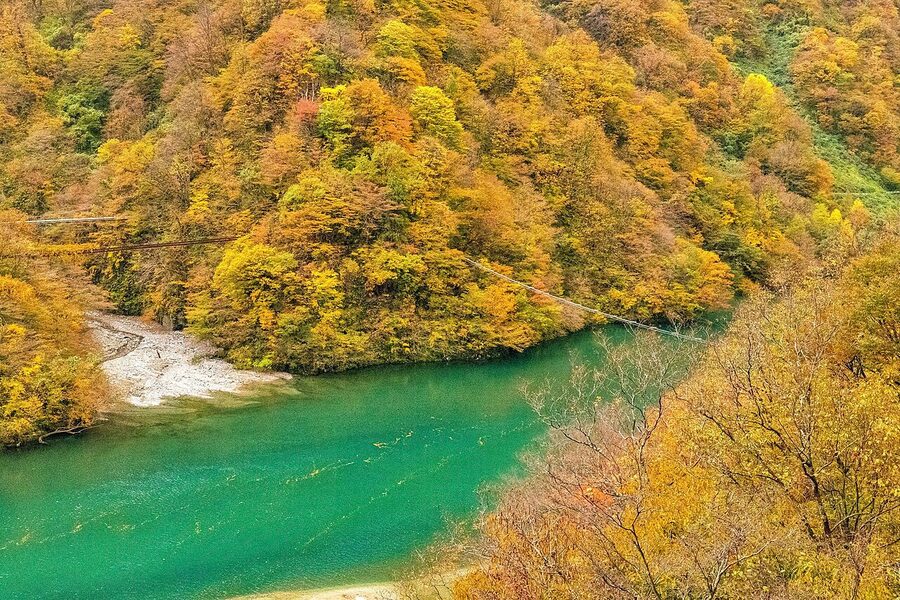
Kurobe Gorge ranks consistently among the top five autumn-colour destinations in Japan, alongside Nikko, Kyoto, and the Hakkoda mountains. The reason is the elevation range: from 224m at Unazuki to about 600m at Keyakidaira, the colour wave moves down the gorge over three weeks rather than peaking on a single day. In a typical year:
- Mid-October: upper Keyakidaira begins to turn. Unazuki is still green.
- Late October to first week of November: peak colour from Kanetsuri up to Keyakidaira. This is the photographer week. Trains from Tokyo are full for the weekend.
- Mid-November: peak colour around Unazuki and Kuronagi. Colours have left the upper gorge but the town still glows.
- Late November: colour past peak, line approaching seasonal closure.
If you can only ride one weekend, target the first weekend of November. Book six weeks in advance for accommodation and three weeks in advance for tickets. Photographers should aim for first or last train of the day to get low-angle light through the gorge; midday gives flat overhead light and harsh contrast. Note also that the cars marked with asterisks on the timetable (ones that operate only between October 1 and November 15) are extra autumn-season services worth knowing about, because they spread the load across more departures.
Other seasons
Late April to early May is the snow-melt and new-green season, with the Mannen Yuki at maximum size and the river running high. Summer is the cool-air season: expect 25-28°C in the lowlands and 20°C up at Keyakidaira, with rain a real possibility. Mid-September is shoulder-season with thinner crowds and the early signs of autumn. Outside late-April to late-November the railway is closed entirely. There is a winter “premium tour” operated some years by snow vehicles into the lower gorge from Unazuki, but it is a tour-bus product, not a train ride.
Photography spots
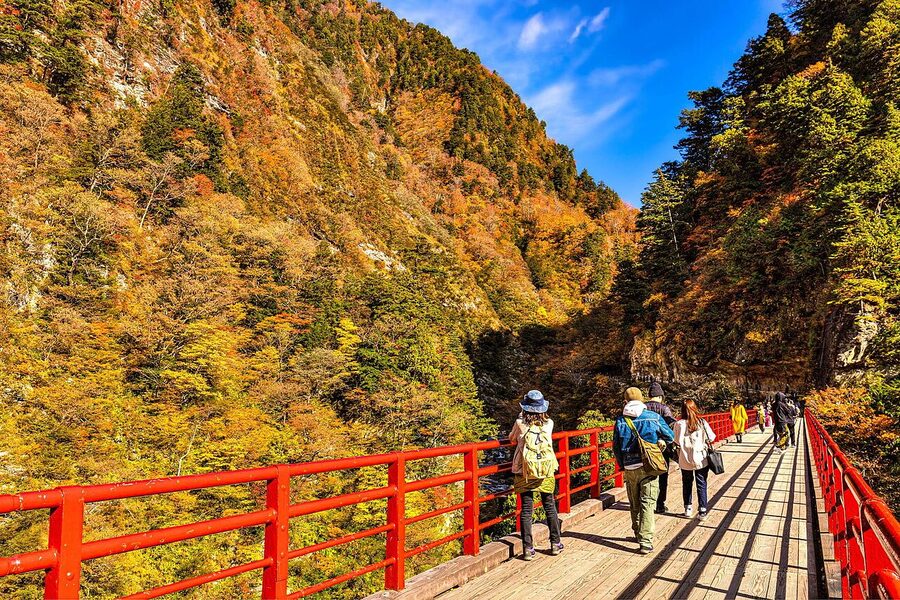
For those carrying a camera, four spots are worth planning around:
- The Yamabiko Observation Platform on the hill above Unazuki Station, looking down at the Shin-Yamabiko Bridge and any passing train. About 15 minutes uphill from town. Better in the morning when the bridge is in light.
- The Atobiki Bridge view from Kuronagi platform: short window between train arrival and departure. Bring a wide lens.
- The Mannen Yuki observation deck at Kanetsuri, with the snow bank and the gorge cliff face. Best from May through August.
- The Okukane Bridge approach at Keyakidaira: photograph the bridge from the lower riverbed, then walk over and shoot back at the station from the Hitokui-iwa side.
Lens choice: a 24-70mm covers most everything from the train carriage; a wider 16-35mm helps with the cliff faces and tunnel-mouth shots. A telephoto is only useful if you’re shooting from a fixed observation deck. From the open-sided carriage, motion blur is a real factor: shutter 1/500 minimum on the move.
Food: the toroko bento and what else to eat
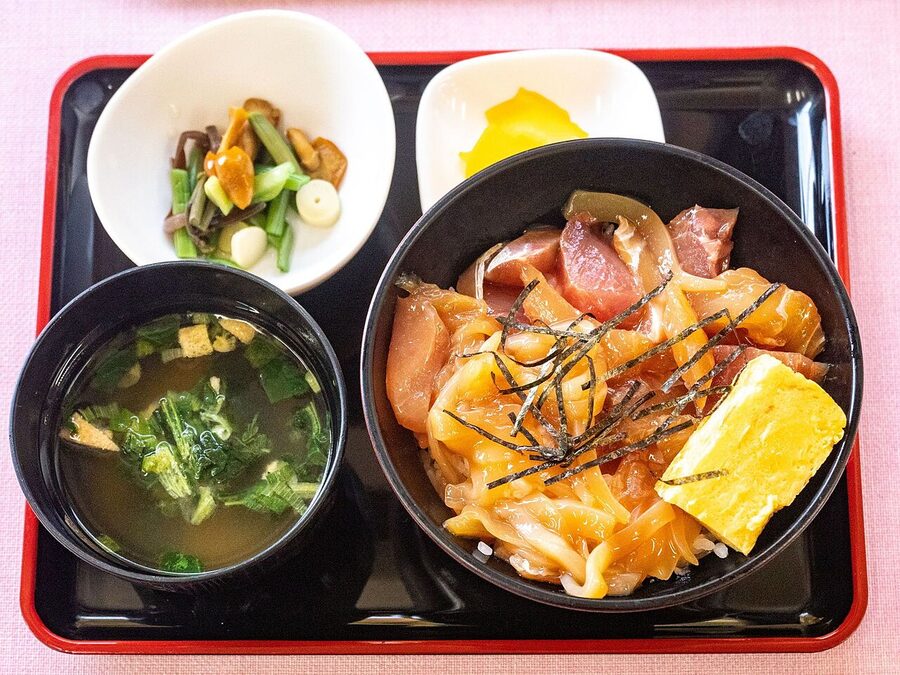
The signature railway food is the Toroko Bento, a wooden box lunch sold at Unazuki Station before departure. It includes a Toyama-style sushi roll wrapped in pickled trout-leaf, simmered local mountain vegetables, a small portion of rice, and a slice of fish. Cost is around ¥1,200, and the box is made from local cedar that you take home as a souvenir. There are usually 200 boxes per day; sell-out by 10:00 on autumn weekends is normal.
At Keyakidaira, the small Restaurant Inn Keyaki serves hot meals: soba, ramen, the local tsuke-don rice bowl, beer. It’s the only proper food at the terminus. Prices are reasonable for a captive audience: noodles around ¥900, rice bowls around ¥1,500. There is also a kiosk selling soft-serve ice cream made with Toyama milk and a separate stand for grilled river fish (ayu and iwana) on weekends.
In Unazuki itself, dinner ideally happens at your ryokan as part of the kaiseki, since most independent restaurants close by 21:00. For lunch or a casual meal, the small soba shops along the main road are reliable and the pricing is honest. Kawamatsu serves a good Toyama-style sushi set for around ¥2,000 and is a five-minute walk from the toroko station.
The Kurobe Dam connection: a separate trip entirely
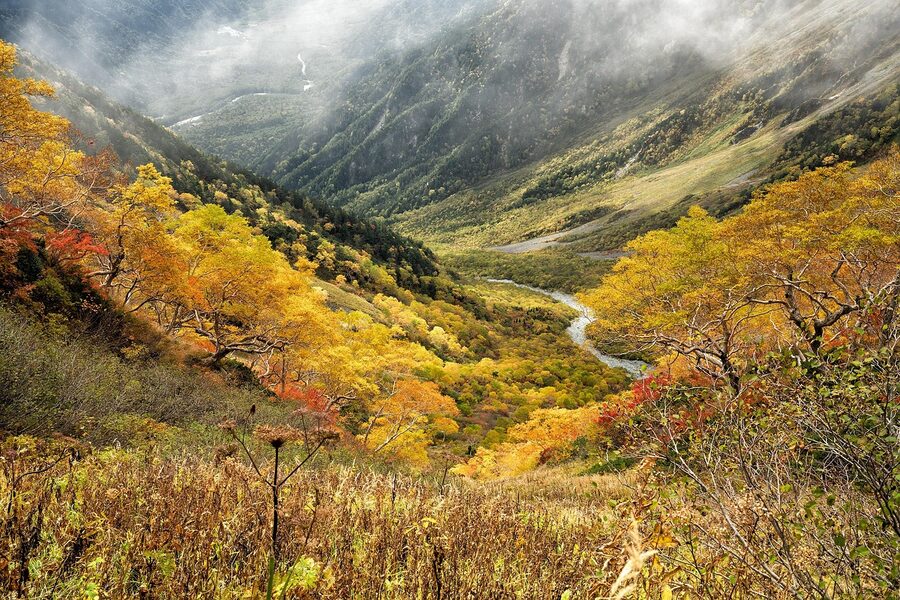
This catches out at least one group of visitors a year, and worth saying clearly: you cannot reach Kurobe Dam from the Kurobe Gorge Railway. The dam is roughly 30km upstream from the railway’s terminus at Keyakidaira, on the same river. Between the two, the line continues another 6km as the Kurobe Senyo-tetsudo, a service railway not open to general passengers, with then a long stretch of gorge that is reached only by mountain hikers on the multi-day “Kurobe Down-Stream Walk” (a controlled route requiring permits and a high level of fitness).
The dam is reached from the eastern side via the Tateyama-Kurobe Alpine Route: trolleybus from Ogizawa on the Nagano side, or the full multi-mode crossing from Toyama via Tateyama Station. That trip is in our separate guide. The two trips are sometimes combined in a four- or five-day itinerary that loops through the gorge, then goes round to the eastern Tateyama side via Toyama City. See our Japan Alps itineraries for sample routings.
The brand-new Canyon Route, and what it changes
Worth a brief flag for travellers planning a 2025 or later trip: in summer 2025, a long-promised new route called the Kurobe-Unazuki Canyon Route is opening for tourist traffic. It uses sections of the existing Kurobe Senyo service railway, plus a tunnel walking section and an inclined cable car, to link the gorge railway end at Keyakidaira directly to the Kurobe Dam side of the mountains. When fully operational, it will be possible to ride the gorge railway up, then continue on a new tour-bus product over to Kurobe Dam, and return on the Tateyama-Kurobe Alpine Route to Toyama, all in a single linked journey. The Canyon Route is run as a guided tour with capped numbers, requires advance booking, and costs significantly more than the toroko ticket. For most travellers in 2026 the standard two-trip approach (gorge one day, Alpine Route a separate day) remains simpler and cheaper. We’ll cover the Canyon Route in its own guide once it has been running long enough to assess.
What to combine the trip with
A round-trip to Unazuki from Tokyo is doable in a long day, but two nights gets you the experience without rushing. Built around an Unazuki overnight, the practical combinations are:
- + Toyama City (1 day): easy add via Shinkansen. Toyama is the regional sushi capital and has the Glass Art Museum. A morning train back to Tokyo from Toyama is straightforward.
- + Tateyama-Kurobe Alpine Route (1-2 days): the headline alpine traverse, accessed from the Toyama side. Best done as a separate trip from the gorge railway, with one or two nights’ buffer between them since both are full-day activities.
- + Kanazawa (1-2 days): a 35-minute Shinkansen ride west of Toyama, with samurai districts, geisha streets, and the Kenrokuen garden.
- + Omachi on the Nagano side: the eastern entry to the Alpine Route. If you want to traverse the Alpine Route in one direction, ending at Omachi (rather than starting from Toyama), this is the natural pairing.
For altitude, none of the gorge stops are high enough to risk altitude sickness. Keyakidaira at 600m is well within normal exertion territory. If you continue from the Alpine Route to Murodo on the high alpine plateau (2,450m), our altitude sickness guide applies.
Practical answers to the questions everyone asks
Is it accessible?
Partially. Unazuki Station is step-free and has a barrier-free Relax carriage available on selected services if you book ahead. Kanetsuri and Keyakidaira have stairs and uneven paths; the trails to the further onsen are not wheelchair-passable. If accessibility is a hard requirement, do the round-trip ride and skip the terminus walks.
Can I bring luggage?
Small day bags only. There are no luggage racks, and the open-sided carriages mean anything large will be in the wind. Coin lockers are available at Unazuki Station; use them.
Is it cold?
Yes. Even in midsummer the upper gorge is 5°C cooler than Unazuki, and at speed the wind on the open-sided cars feels another 5°C cooler still. A fleece is essential April-May and September-November. In peak summer a long-sleeved shirt is enough.
Wet weather?
The line runs in light rain. In moderate rain the open-sided cars are uncomfortable; the Relax car is your friend. Heavy rain occasionally suspends operations, since rockfall is a real risk on the cliff sections. Check the operator’s website on the morning of travel.
How long should I plan?
If just the train: about four hours total from arrival at Unazuki Station to return to your hotel, including the round trip and a snack stop at the terminus. With Keyakidaira walks: five to six hours. With an onsen stop at Kuronagi or Meiken: seven to eight hours, plus the next train back. Add another hour buffer for the autumn-colour fortnight when crowds slow everything down.
Cash or card?
Tickets at the station accept credit cards and cash. The food kiosks at the intermediate stations are mostly cash-only. Carry ¥10,000 in small notes per person for a comfortable day.
One small detail to close on
The thing that stays with you isn’t the bridge or the Hitokui-iwa or even the autumn colour. It’s the sound. The 10-metre rail sections give the train a rhythmic clack at every joint, and the open carriages mean you hear the river running below the wheels almost the entire way up the gorge. By the time the train pulls into Keyakidaira and the engine cuts, the silence afterwards is the loudest part of the day.


.jpg)


