Twenty-three. That’s how many wooden festival floats Takayama keeps under careful guard, twelve for spring and eleven for autumn, every one of them designated a National Important Tangible Folk Cultural Property and quietly stored in white-walled lock-up sheds for 360 days a year. The other five days they roll out into the streets, three of the spring twelve perform mechanical puppet plays you won’t see anywhere else in Japan, and the rest of the time they sleep behind heavy timber doors that the locals will point out to you if you slow down long enough to ask.
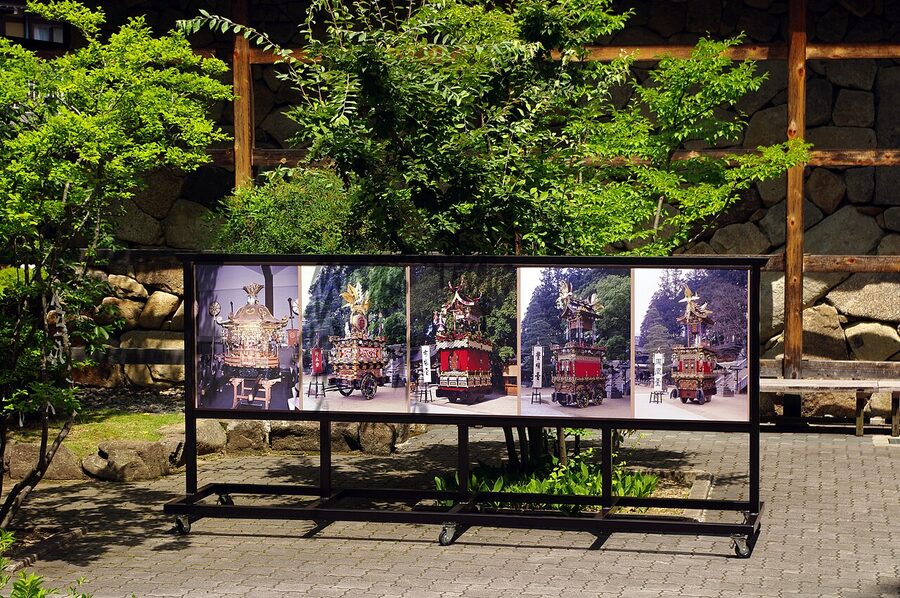
If you’re trying to time a trip to Takayama around the festival, the first thing to understand is that there are two of them. They’re held at opposite ends of the year and at opposite ends of the old town. They share a vocabulary, a craft tradition, and a couple of hundred families’ worth of obligation, but they’re organised by separate shrines and feature different floats. Locals don’t usually call either one “Takayama Matsuri” out loud. It’s Sanno Matsuri in spring and Hachiman Matsuri in autumn. The combined name is more for outsiders.
This guide covers both, with practical detail on where to stand, what to look for, what most people miss, and a long-overdue answer to the question every traveller asks: which one should I go to?
In This Article
- The two festivals at a glance
- The yatai: why everyone’s here
- The spring twelve
- The autumn eleven
- What actually happens, hour by hour
- The karakuri: probably the only puppet show that justifies the queue
- The mikoshi processions
- The night parade is the moment
- Where to watch each piece
- The Yatai Kaikan: the year-round option
- Hie Shrine and Sakurayama Hachimangu
- Spring or autumn: which one?
- The accommodation problem
- Getting there
- Two practical things most guides miss
- What to combine it with
- One last thing
The two festivals at a glance
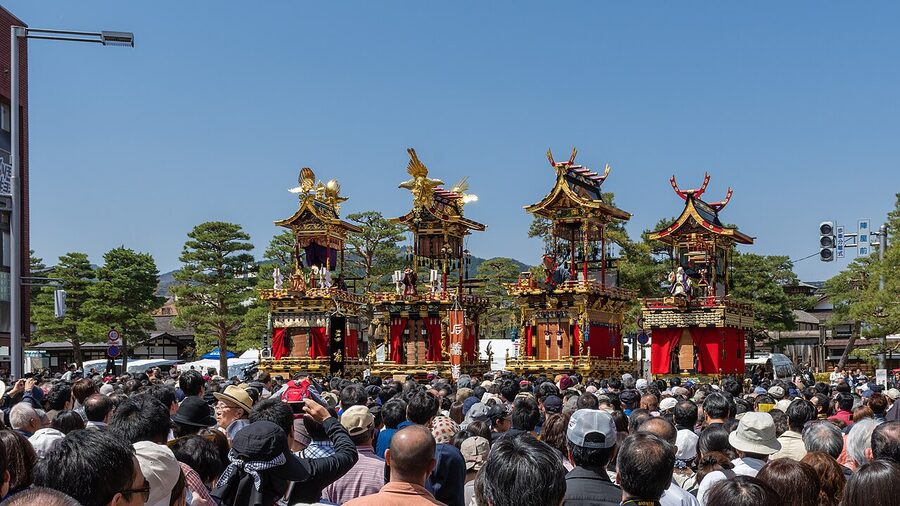
Same vocabulary. Different shrines, different streets, different float collections. Here’s the short version, then we’ll go into each in detail.
- Spring, Sanno Matsuri / 春の高山祭. Held every year on 14–15 April. Centred on Hie Shrine in the southern half of the old town. Twelve yatai. Around 194,000 visitors over the two days in a typical year.
- Autumn, Hachiman Matsuri / 秋の高山祭. Held every year on 9–10 October. Centred on Sakurayama Hachimangu Shrine in the northern half. Eleven yatai. Around 252,000 visitors.
Both pre-date the records that confirm them. The earliest documented spring festival is 1652 (Keian 5), based on a 1692 reference to “festival rites held every three years for the past 40 years.” The autumn festival traces to 1716 (Kyoho 1). Both were inscribed on the UNESCO Intangible Cultural Heritage list in December 2016 as part of the wider Yama, Hoko and Yatai float festivals registration.
Two practical notes that will save you grief later. First, both festivals are cancelled in rain. The yatai are too valuable and too fragile to take out in bad weather. If it rains on 14 April, the floats stay in their kura. The shrine ceremonies still go ahead, but the spectacle you came for doesn’t. Second, both festivals depend on hotel rooms booked ridiculously far in advance. By “ridiculously far” I mean six to twelve months. More on that below.
The yatai: why everyone’s here
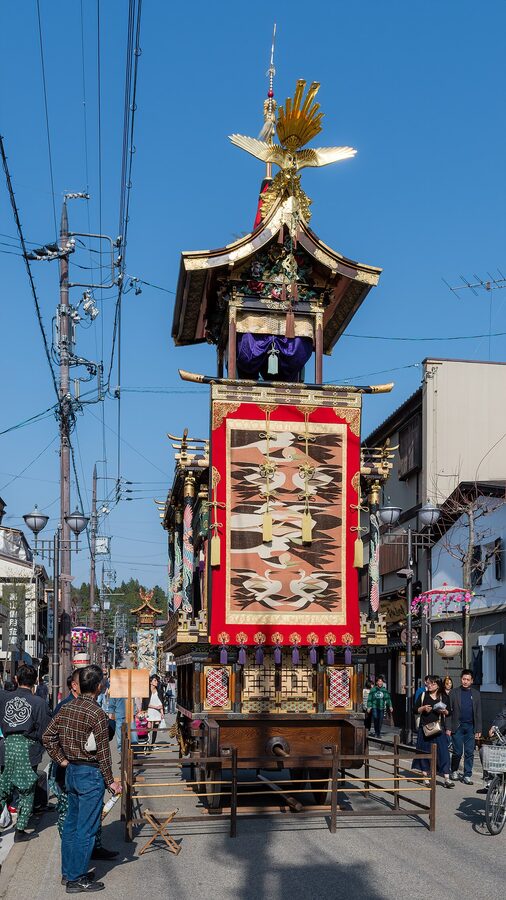
The yatai are what people come for. Together with the floats of Kyoto’s Gion Matsuri and Saitama’s Chichibu Yomatsuri, they’re considered one of Japan’s three great float-festival traditions. They’re often nicknamed the “moving Yomei Gate,” after the famously over-decorated gate at Nikko’s Tosho-gu, and once you’ve seen the carving and gilding up close you understand the comparison.
The current floats date mostly from the 18th and 19th centuries. The earliest recorded build dates to the Horeki era (1751–1764). They were built by Hida craftsmen using imported textiles from Kyoto, gold-thread embroideries from China, and, in at least one famously persistent case, springs cut from the baleen of right whales. The whale-spring detail isn’t a curiosity; it’s a maintenance problem. The springs in the karakuri puppets cannot be replaced with steel or with baleen from any other species. They have to be original or near-original, and they have to be repaired, not substituted. Which is one reason why only three of the spring twelve still perform their puppet plays publicly.
Each yatai weighs several tonnes, sits on four solid wooden wheels, and reaches as high as 11.74 metres in the case of Hooutai, the spring festival’s tallest. They’re escorted through the town by men in hakama and kamishimo, the formal Edo-era dress, and on the corners they don’t turn so much as they’re jacked, a mechanism inside the float lifts two of the four wheels off the ground so the third “return wheel” can pivot. You can see the operation if you’re standing in the right spot at the right corner. The crew works fast and silent.
The spring twelve
The Sanno Matsuri’s twelve floats represent the southern half of the old town, the yatai-gumi (float groups) of the streets south of the Yasugawa-dori. From the front of the parade backwards, they are Kaguratai, Sanbaso, Kirintai, Shakkyotai, Godaisan, Hoouutai, Ebisutai, Ryujintai, Kongotai, Kinkotai, Daikokutai, and Seiryutai. Three more, Koukakutai, Ouryutai, Nansha-tai, are listed as kyu-tai, “resting floats,” that no longer process. Kaguratai always heads the parade because it carries the great taiko drums; the order of the others is decided by lottery at Hie Shrine on 1 March, which is itself a small ceremony called the chusen-sai.
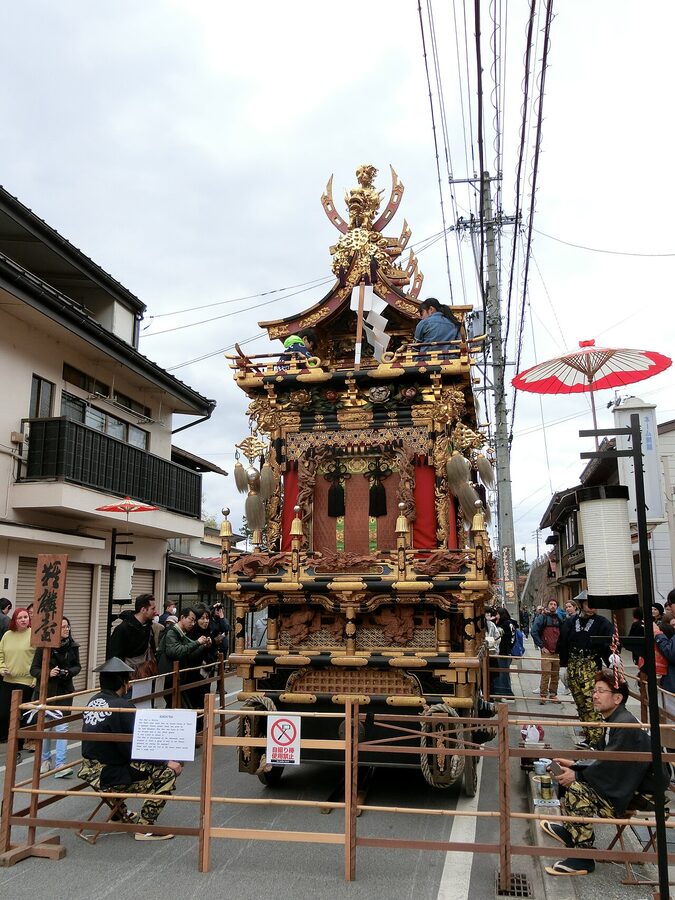
If you only have time to study a few up close, look at Hoouutai for sheer scale (it’s the tallest), Sanbaso for the puppet trick where an old man transforms by opening a treasure box, and Ryujintai for the most theatrical of the karakuri performances, a dragon-god trapped in a jar by drunken children, who breaks out and dances. Kirintai’s “caged rooster” carving, hand-cut from a single block of wood so the bird sits behind real bars carved from the same piece, is the kind of detail that locals will quietly point you toward.
The autumn eleven
The Hachiman Matsuri’s eleven floats belong to the north-of-Yasugawa neighbourhoods. Several were lost to a fire in 1875 and never rebuilt. Hoteitai is the headline act, the only autumn float that still performs karakuri, and the most technically demanding puppet sequence in either festival. Two children-acrobats spring across a sky-ladder of ropes and land on the shoulders of the seated god of fortune, all controlled by nine puppet-masters working 36 strings from inside the float. People who’ve watched it dozens of times will tell you they still don’t know exactly how the landing works.
The autumn order is run by nen-gyoji, year-managers chosen from four float groups, with another four supplying deputies. Unlike the spring lottery, autumn order is set by rotation. Each year a different yatai-gumi takes the lead.
What actually happens, hour by hour
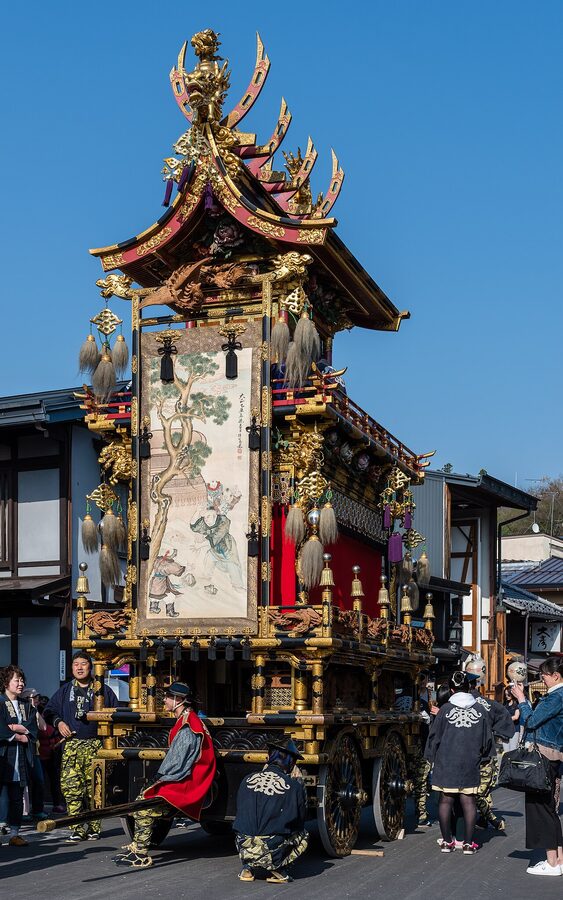
If you arrive on day one having read nothing in advance and try to follow what’s going on, you’ll be confused. The festival is technically four discrete things stacked into the same two days: the float display (yatai-hikisoroe), the karakuri puppet performance, the procession of the portable shrine (goshinko in spring, goshinkou in autumn), and the night float parade (yomatsuri in spring, yoimatsuri in autumn). Each runs on its own clock and route.
Here’s the timing as it stands for both festivals. These hours are stable year to year; the dates are not.
- 9.30am to 4pm (spring) / 9am to 5pm (autumn): Float display in the streets near each shrine. Walk between them at your own pace. Best photography window is the first hour.
- 10–10.50am and 2–2.50pm (spring): Karakuri puppet plays performed beside Takayama Jinya, in front of the temporary otabisho shrine. Get there 30 minutes early or you’ll watch shoulders.
- 12–12.20pm and 2–2.20pm (autumn 9th); 11–11.20am and 1–1.20pm (autumn 10th): Karakuri performances at Sakurayama Hachimangu shrine grounds. Same rule applies on early arrival.
- 1pm onward (spring 14th): Goshinko procession leaves Hie Shrine and walks the parishioners’ streets, carrying the deity in a portable shrine to spend the night at the otabisho. The procession is roughly 300 people in formal Edo-period dress with a sacred tree at the head and the Miyamoto-bata banner at the rear. On the 15th it returns to Hie Shrine in the afternoon.
- 1.20–3.30pm (autumn 9th); 8.30am to 4pm (autumn 10th): Goshinkou procession routes from the temple road (Omote-Sando) and back. The autumn version adds an afternoon yatai parade on the 9th, four floats that move through town in formation. Two of those four are always the same; the other two rotate each year.
- 6.30pm to roughly 9pm (spring 14th); 6.15pm to roughly 9pm (autumn 9th): Yomatsuri/yoimatsuri night float parade. Each yatai is hung with around 100 paper lanterns and pulled slowly through the dark streets. As they break formation to head home, each crew sings Takai Yama, the festival’s parting song.
The night parade is the part most travellers describe as the “moment.” If you can only do one thing on day one, do that.
The karakuri: probably the only puppet show that justifies the queue
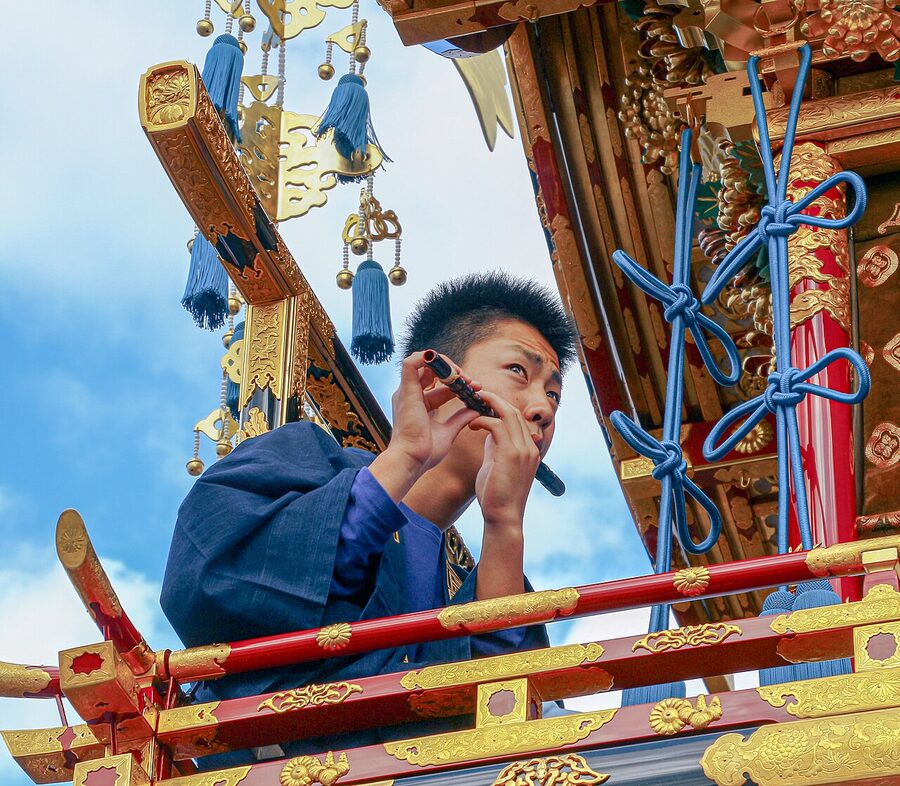
I’ll say this once and not hedge: the karakuri performance at Takayama is the only piece of festival programming in Japan that I think genuinely repays a 30-minute wait. The puppets are 200-year-old wooden figures built into the upper deck of three of the spring yatai (Sanbaso, Ryujintai, Shakkyotai) and one of the autumn floats (Hoteitai). They’re operated from inside the float by anywhere between 6 and 9 puppet-masters, who control 36 strings and a network of bamboo push-rods.
The technical fact about them, that the springs are cut from baleen, that the parts can’t be replaced, that the masters train for decades, sets up an expectation. But what actually surprises you on the ground is that the puppets think. They hesitate. They look around. The dragon-god in Ryujintai’s sequence pauses on the rim of his jar, sees the children who put him there, and you genuinely register him deciding to be furious. It’s strange and it’s brief, maybe four minutes per cycle, and you’ll want to watch it twice.
Be there 30 minutes before the published time. The audience packs in front of the otabisho or shrine grounds and the front rows are taken up by photographers with tripods who got there at 9am.
The mikoshi processions
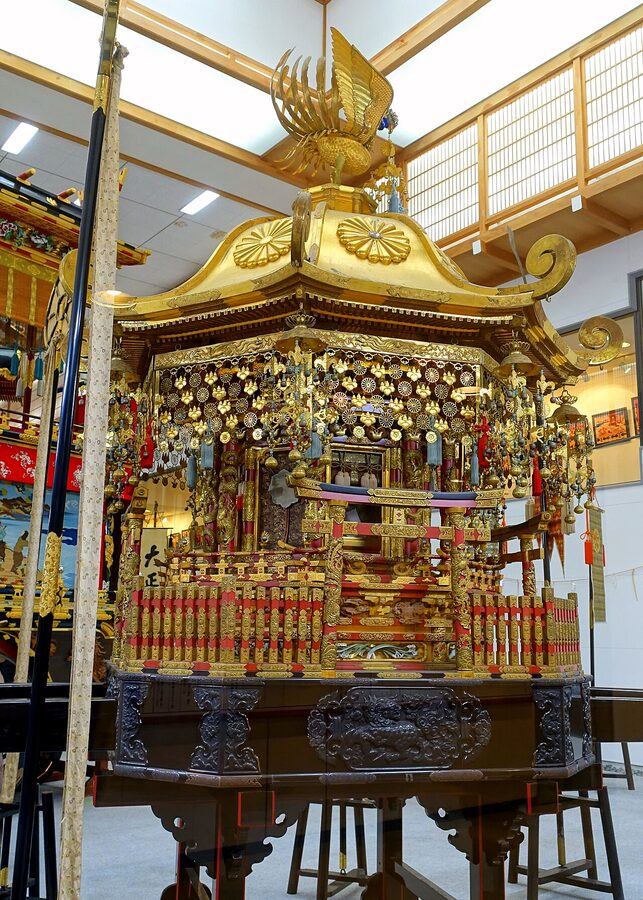
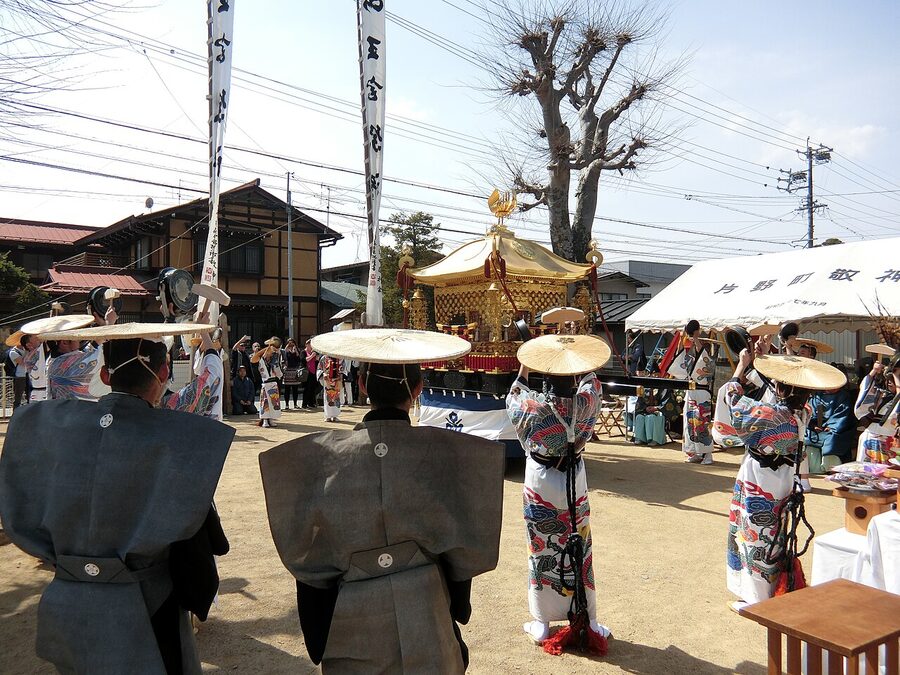
The float display gets the photos, but the procession of the mikoshi is the religious heart of both festivals. This is the only time of the year when each shrine’s deity leaves the inner sanctuary and visits the parishioners’ streets. The portable shrine is escorted by a roughly 300-strong procession in Edo-period costume, fronted by a great sakaki tree branch and rear-flanked by the Miyamoto-bata banner.
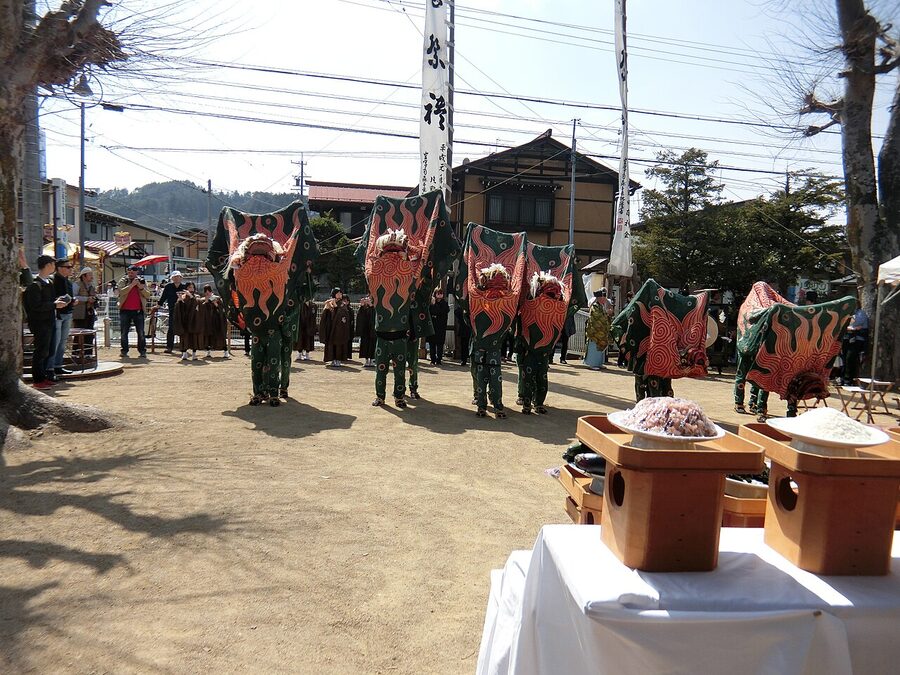
The accompanying performances are worth watching even if you’re not following the procession. Tokeiraku is a percussive bell-and-drum routine performed by men in distinctive Hida-region costume; shishimai (lion dance) is performed by the Morishita-gumi at Sanno and the Sakyo-jishi tradition at Hachiman, the latter going back to the Enpo era of the 1670s. Both are hypnotic to watch when the procession pauses at a parishioner’s house and the dancers do a private set on the front stones.
The night parade is the moment
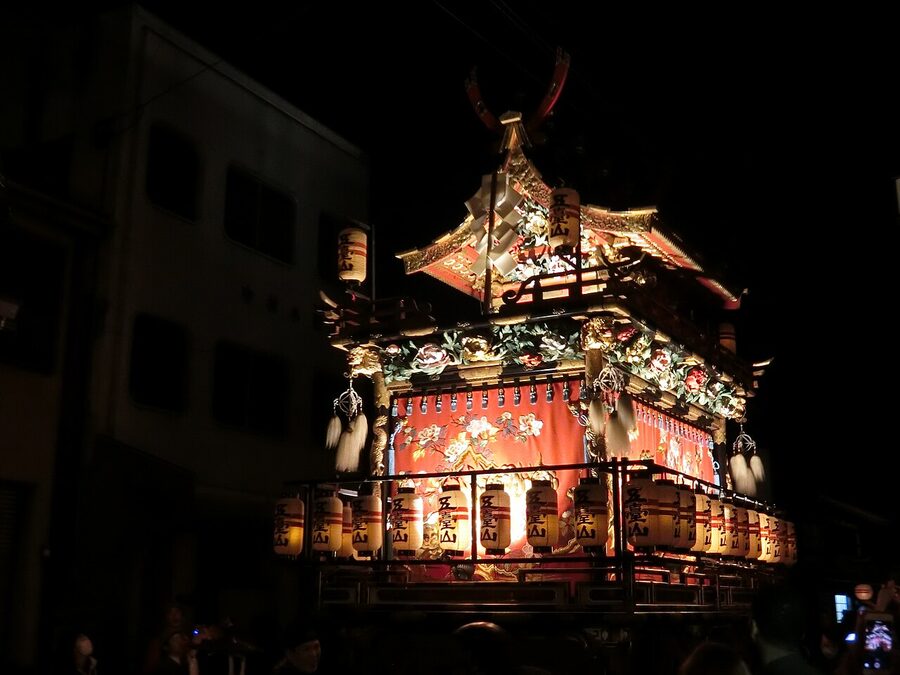
If I had to recommend a single hour of the festival to a first-timer, it would be the start of the yomatsuri/yoimatsuri. The yatai are pulled out of their day positions, hung with 100 paper lanterns each, and walked slowly through the dark streets. The wood gets warmer in the lantern light. The lacquer drinks the colour. The metal fittings glint and the crowds drift quiet around them.
Two pieces of practical advice. First, the best vantage points are the small bridges, Nakabashi (the iconic red bridge over the Miya river) for spring, and Yanagi-bashi for autumn. The crowds gather there and the floats cross slowly. If you set up an hour before, you can hold a position. Second, the parade ends with the floats heading back to their kura singing Takai Yama. It’s a slow, plain song, and the moment when the lanterns disappear into the wooden doors of an unmarked street-side warehouse is the one I’d remember if I had to keep just one.
Where to watch each piece
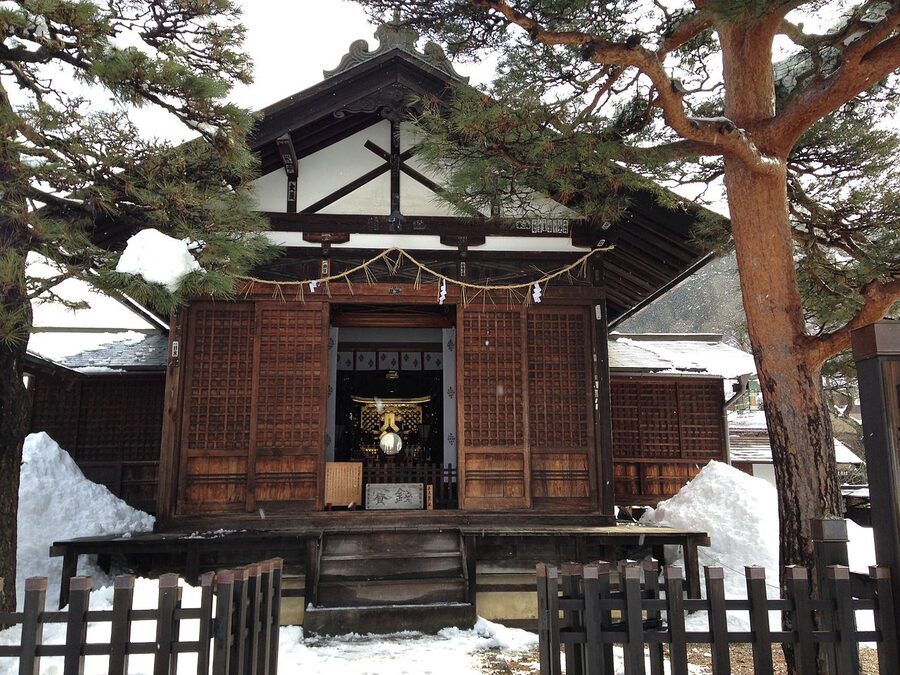
For the spring festival, the geographic centre of gravity is roughly the area bounded by Hie Shrine, the Sanmachi old-town district, Nakabashi bridge, and Takayama Jinya. You can walk it in about 25 minutes from end to end. Hie Shrine is a 25-minute walk from JR Takayama Station; the otabisho is 5–10 minutes from the station via the bridge.
For the autumn festival, the centre is Sakurayama Hachimangu, a 20-minute walk north of the station. The yatai display extends down through the streets immediately south of the shrine. The Yatai Kaikan, which we’ll cover next, sits right beside Hachimangu and stays open during the festival as a paid alternative to standing in the street.
If you only have one full day, my structure for the spring festival would be:
- 9am: walk from the station to the otabisho via Nakabashi. Float displays already up.
- 9.30am: Sanmachi old town as the floats finish lining up.
- 10am: karakuri at the otabisho (arrive 9.30 to get a spot).
- 11am to 1pm: drift through the float display streets at your own pace, eat from the food stalls.
- 1.30pm: catch the goshinko procession leaving Hie Shrine.
- 3pm: rest. You will need to.
- 5.30pm: position on or near Nakabashi for yomatsuri.
- 6.30pm onward: yomatsuri.
On day two of the spring festival the floats display again from 9.30am, the goshinko procession returns to Hie Shrine in the afternoon, and there’s no second night parade, that’s a one-night affair. If you have two days, day two is the slower, quieter day. Many travellers leave on day two morning. I’d argue against that. The 14–15 split exists for a reason; the second day’s afternoon procession is calmer and the carving on the parked floats is easier to study without a crowd.
The Yatai Kaikan: the year-round option
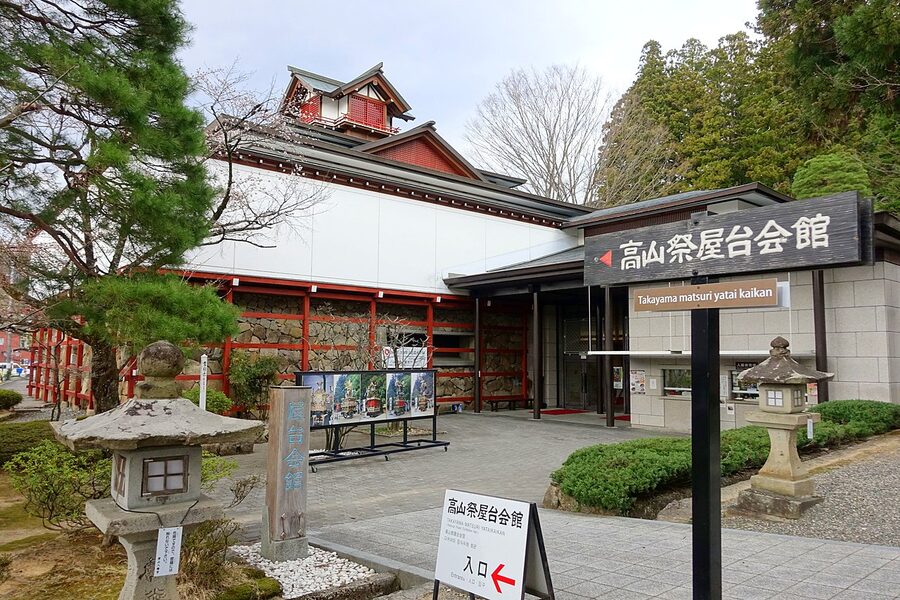
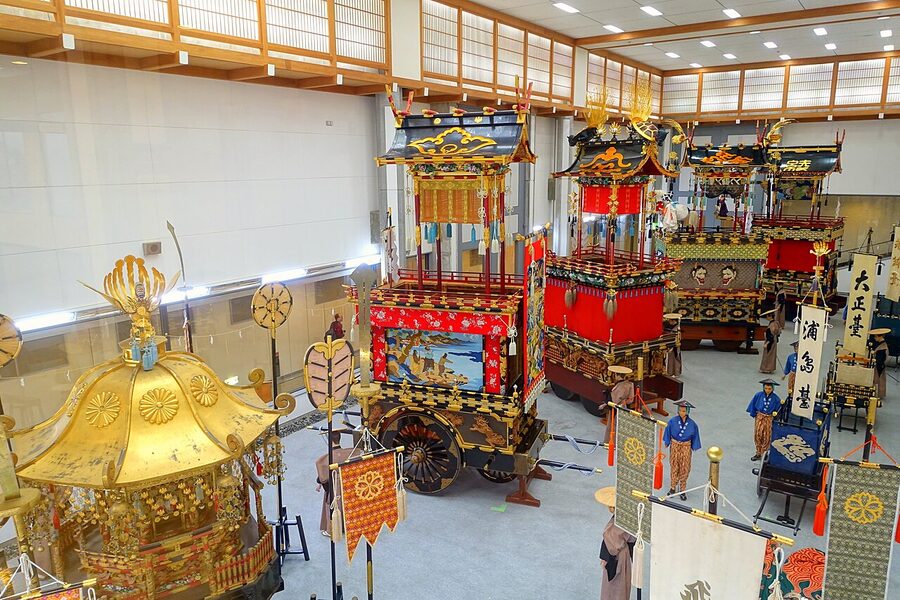
If you can’t time your trip to the festival itself, or you want to study the floats up close without a crowd in front of them, you’ll spend a couple of hours at the Takayama Matsuri Yatai Kaikan (高山祭屋台会館) on the grounds of Sakurayama Hachimangu. It’s the official year-round home of four of the autumn eleven, rotated three times a year so that the same float never sits more than a few months in display lighting.
Practical detail. The Yatai Kaikan is a 15–20 minute walk from JR Takayama Station, on the north side of the old town. Open March to November, 8.30am–5pm; December to February, 9am–4.30pm. Admission is ¥1,000 (it includes the adjoining Sakurayama Nikko-kan, a precise 1/10-scale model of Nikko Tosho-gu). On rainy festival days when the actual yatai stay in their kura, the Yatai Kaikan opens its outer doors so passing visitors can see the floats inside without paying admission, an old courtesy that not many other museums extend.
One detail you’ll only notice on the ground: the floats inside the Kaikan are the only ones in the world built where you can walk under and see the underside, the place where the lacquer and the metal fittings continue, “where the work is amazingly detailed,” as the museum’s English signage drily puts it. They’re not wrong. The undersides are where the truly obsessive carving happens.
If you’ve already been to the Yatai Kaikan and want a second museum, Takayama Matsuri no Mori (飛騨高山まつりの森), out at the eastern edge of town, holds a different set of replica yatai inside an underground hall and rotates a real karakuri sequence four or five times a day. It’s not a substitute for the festival itself, but it’s a reasonable rainy-afternoon plan. Some traveller forums prefer it; others find it slightly theme-park. I’d say if you have one museum afternoon, do the official Kaikan first.
Hie Shrine and Sakurayama Hachimangu
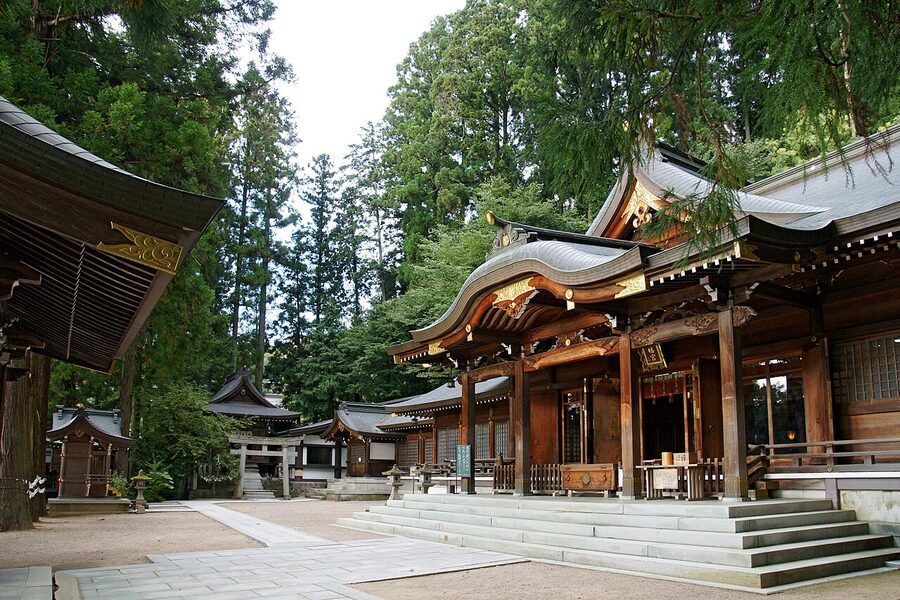
Hie Shrine (also called Sanno-san) is the spring festival’s home shrine. It sits on the lower slopes of Shiroyama, where Takayama Castle once stood, and it’s an active shrine the rest of the year too, quiet, mossy, and worth the 25-minute walk from the station even in non-festival months. The famous Hie Hooutai yatai’s dedication ceremony happens here on 14 April morning before the floats come down to the streets.
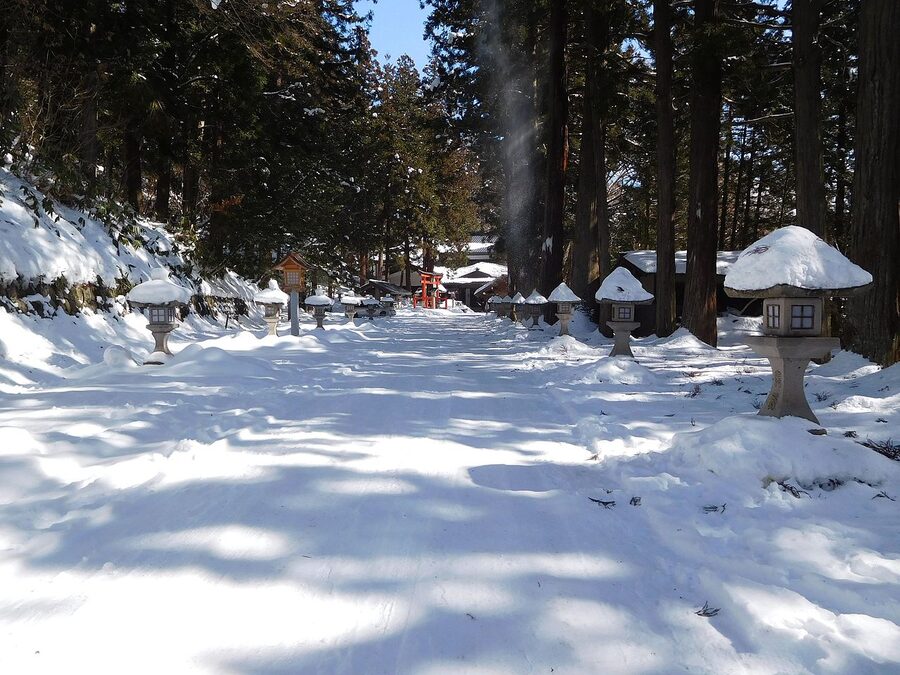
Sakurayama Hachimangu, on the north end of the old town, hosts the autumn festival. The grounds are larger than Hie’s, with a wide approach lined with stone lanterns and the Yatai Kaikan immediately adjacent. During the autumn festival the inner shrine is where the karakuri performance happens; the rest of the year, the shrine is a perfectly pleasant 30-minute add-on to a walk through the old town.
Spring or autumn: which one?
This is the question every traveller sends an email about. There isn’t a wrong answer, but there are real differences.
Spring (Sanno Matsuri, 14–15 April) coincides, in years when the weather cooperates, with the local cherry blossom. Takayama is at 573m elevation, so its sakura runs about a week behind Tokyo’s. In a typical year the trees along the Miya river are in their last full bloom on 14 April. The combination of falling petals and the lacquered yatai is what most photography of the festival sells. It’s also colder than people expect: 5–15°C through the day, with the nights well below 10°C. Bring a layer for the yomatsuri.
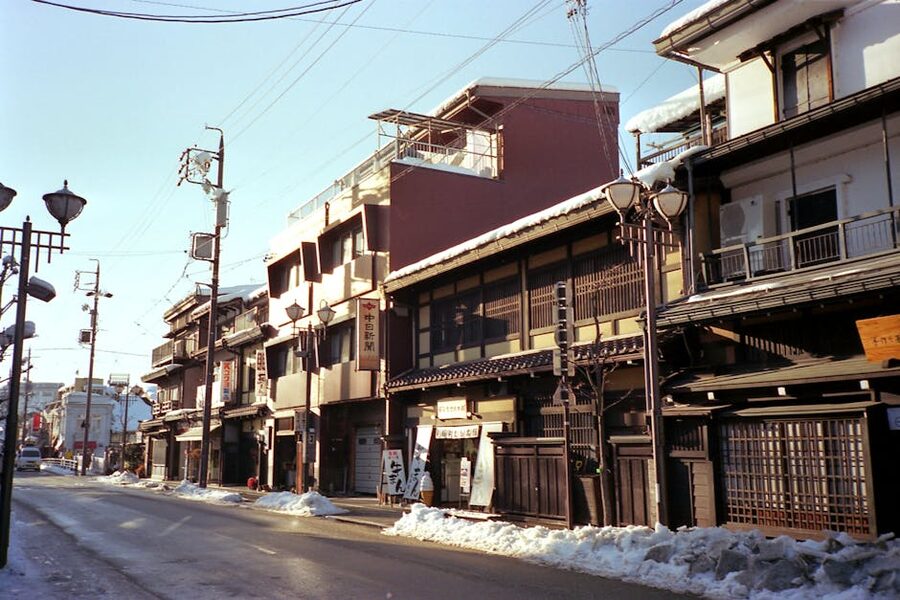
Autumn (Hachiman Matsuri, 9–10 October) is sharper, drier, and earlier in the autumn colour cycle than people imagine. The travel writer who told you the festival hits peak foliage was wrong. Takayama’s koyo (autumn leaves) peak in the third week of October, sometimes early November. On 9–10 October the trees in town are still mostly green, with the first yellow on the higher hills. The compensating advantage: clearer skies, fewer rain cancellations, and slightly lower hotel demand than spring. If you want a higher chance of actually seeing the yatai roll, autumn is the safer bet.
The shorter answer: if you want the photo you’ve seen on every guidebook cover, go in spring and gamble on the weather. If you want to actually see the festival run, go in autumn.
The accommodation problem
You should book your festival-week accommodation between six and twelve months in advance. I’m not exaggerating. By February for the spring festival, by May for the autumn one, the central Takayama hotels and ryokan close their festival-night inventory entirely. By March/June, the secondary belt of properties, Honjin Hiranoya Kachoan, Spa Hotel Alpina, Hotel Ouan, are gone. By festival week, the only available rooms inside the city limits are the ones nobody wants for a reason.
If you’ve left it late, two strategies work. The first is to base in Hida-Furukawa, 20 minutes north on the JR Takayama line. Furukawa runs its own festival on 19–20 April (different floats, different shrine, smaller crowds), and outside its own festival week the rooms are quieter and roughly 20% cheaper than Takayama’s. The second is to base further out, in Hirayu Onsen in the Okuhida hot-spring villages an hour’s bus east of Takayama. There’s a regular bus, the inns are largely traditional ryokan with onsen baths, and the cost is competitive. You’ll need to leave the festival village by 9.30pm to catch the last bus, which means missing the very end of the yomatsuri.
For a fuller treatment of where to stay in Takayama proper, ryokan vs hotels, festival-week alternatives, the area-by-area breakdown, see our separate where to stay in Takayama guide.
Getting there
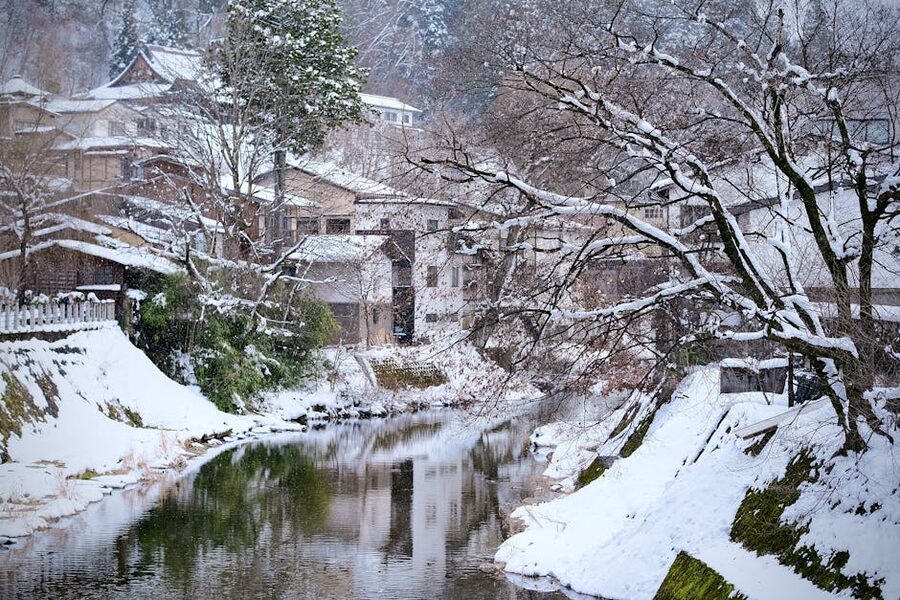
Takayama is on a single rail line: the JR Takayama Honsen, running between Toyama in the north and Gifu in the south. The fastest route from Tokyo is Tokaido Shinkansen to Nagoya (about 100 minutes), then the JR Limited Express Hida bound for Toyama, getting off at Takayama (about 2h 20m). Total Tokyo–Takayama, around 4h 20m, around ¥15,000 reserved seat. From Kyoto the route runs Kyoto–Nagoya by Shinkansen (35 mins), then the same Hida limited express. The Shinkansen Hokuriku line via Kanazawa and Toyama is also workable, though slower; you’ll change to a local at Toyama.
If you’re coming straight from Narita or Haneda and not stopping in Tokyo, the cheaper route is the Nohi Bus express service, Tokyo–Takayama direct, 5h 30m, no transfers, around ¥7,500. It’s a long ride but the bus runs straight to the front of Takayama Station’s bus terminal.
For more detail on routes, prices and the Hida limited express in particular, see the access guide.
Two practical things most guides miss
1. The 1 March lottery is itself worth a visit. If you’re already in Takayama in early March, the chusen-sai ceremony at Hie Shrine on 1 March, when the order of the spring floats is decided by lottery for the coming year, is a small, slightly odd event with maybe 30 or 40 onlookers, mostly locals from the float groups. It’s not on the tourist circuit. It’s a five-minute walk from Takayama Station and the actual lottery takes about 20 minutes.
2. The week before the festival is the float-prep week. The locals call it yatai yawai, yawai being Hida dialect for “preparation.” The kura doors swing open, the floats come out, and the curtains and ornaments are fitted in public view. If you visit Takayama in the week before either festival, you can wander the back streets and watch the prep work going on. It’s the only time outside the festival itself when you can see a yatai outside its kura without a crowd.
What to combine it with
The festival eats two days. If you’ve come this far, you’ll want at least two more in town. A reasonable structure for festival-trip planning:
- Day before: Arrive late afternoon. Walk the Sanmachi old town at dusk before the float prep week starts.
- Festival day 1: See above.
- Festival day 2: Morning float display, afternoon procession. You’ll want a slow lunch.
- Day after: Day-trip to Shirakawa-go (50 minutes by bus) for the gassho-zukuri thatched houses, or to Hida-Furukawa for the smaller, quieter sister festival town. Either is a fair full day.
- Day after that: The Hida Folk Village (Hida no Sato), the morning markets at Miyagawa and Jinya-mae, and a relaxed dinner.
If you’ve never been to Takayama before, the festival is the wrong introduction. It’s the right second visit. The first visit should be a quiet weekend in autumn or late spring when the town is operating at its normal pace and you can taste the food and walk the temple loop in the eastern hills without dodging a procession. Then come back for the festival when you already know the geography.
One last thing
The festival’s parting song is a slow piece called Takai Yama, “high mountain.” It’s sung by the float crews as they head home from the yomatsuri, dispersing each yatai to its kura before the night ends. By 10pm the streets are quiet and the wood doors of the warehouses are closed and you can stand in the lane outside one of them and hear the muffled scrape of wheel-blocks being chocked into place behind it. The crew inside doesn’t speak. They wipe down the lacquer with cotton cloths and then they switch the lights off and they go home, and the float sits in the dark for another 360 days.