
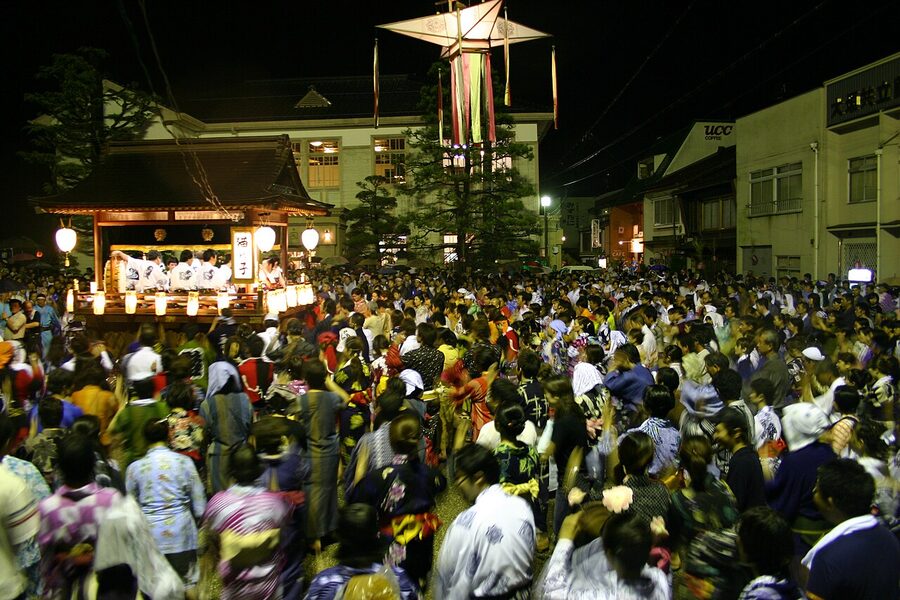
For four consecutive nights every August, the people of a 17,000-strong castle town in Gifu start dancing at 20:00 and stop at 05:00 the next morning. They do this on the streets, in straw sandals, in wave after wave around a wooden tower called a yagura, and they have been doing it for roughly 420 years. The town is Gujo Hachiman, and the four nights are called the Tetsuya Odori, the all-night dance, on 13, 14, 15 and 16 August. Outsiders are welcome. There is no audience. You either join the circle or you go home.
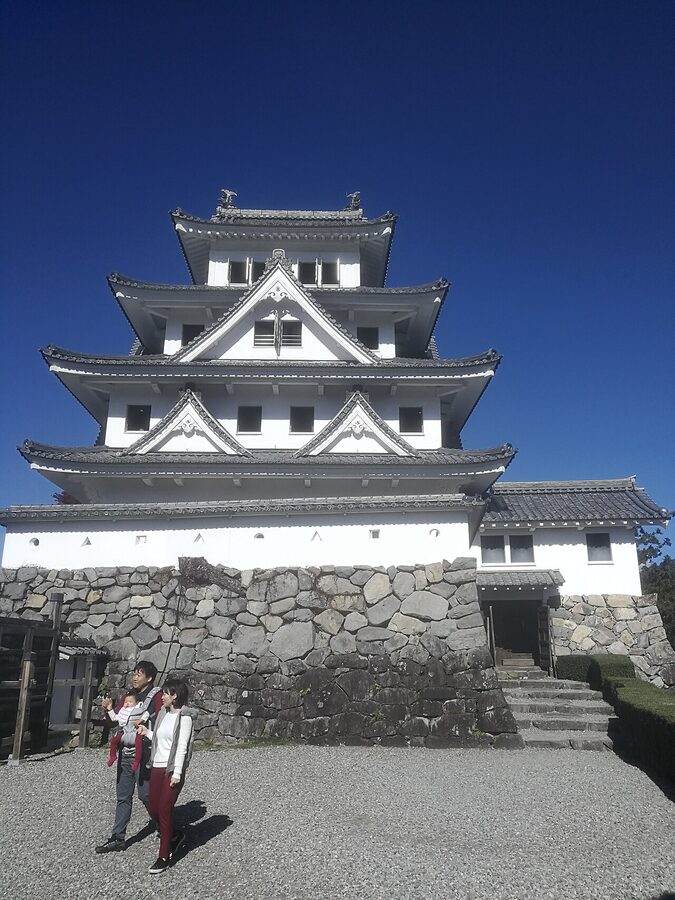
That is the headline reason most Japanese travellers make the trip up the Nagara River valley. But the dance is only one of four reasons Gujo earns a stop, and on any other 360 days of the year the other three carry the visit alone. The water runs so clean through the central canals that koi the size of a forearm live in the drainage ditches. The plastic ramen, tempura and parfaits in restaurant windows across the entire country: roughly half of them are made here. And the castle on the ridge above town is the oldest wooden reconstruction castle in Japan, finished in 1933, sometimes wrapped in autumn fog so the keep appears to float free of the mountain.
In This Article
- Four reasons to make the trip up the river
- Where exactly Gujo Hachiman is, and how to get there
- From Nagoya
- From Takayama
- The slow scenic option: Nagaragawa Railway
- By car
- The Gujo Odori, and how to actually dance it
- The four nights that matter most: Tetsuya Odori
- The ten dances
- What to wear and what to bring
- The Hakurankan museum, year-round
- Hachiman Castle, the oldest wooden reconstruction in Japan
- Getting up there
- What’s inside
- When the castle “floats”
- The water town: koi in the drainage ditches, springs you can drink
- Igawa Komichi (Igawa Lane)
- Sogi-sui, the spring with a name
- Yanaka Mizu no Komichi
- The Yoshida River and the bridge-jumping kids
- Plastic food: where Japan’s restaurant samples are made
- Sample Kobo (Sample Workshop)
- Sample Village Iwasaki
- The merchant streets and the temples
- The 13 temples
- The shrines
- Where to eat
- Bistro Mu
- Soba Hirajin
- Shinbashitei
- Cafe Komugi
- Okumino curry: a local oddity
- Food walking, by season
- Where to stay
- Miharaya Ryokan
- Sekisuien
- Hotel Gujo Hachiman
- Camping at Mt Washigatake
- Or stay in Takayama
- When to visit
- Spring (mid-March to late May)
- Summer (June to early September)
- Autumn (mid-September to late November)
- Winter (December to mid-March)
- What to combine Gujo with
- Takayama (one hour north on the same expressway)
- Shirakawa-go (90 minutes north on the same expressway)
- Magome and Tsumago (the Nakasendo, 90 minutes south-east)
- Kanazawa (three hours north-west)
- Nagoya itself
- Wider planning
- A few small things, in closing
Four reasons to make the trip up the river
Most travellers come for one of these and find themselves pleasantly ambushed by the others. The trip is short enough from Takayama or Nagoya to plan around whichever angle pulls you, then absorb the rest as bonus.
| Angle | When it works | Time on site | Best for |
|---|---|---|---|
| Gujo Odori dance festival | Late July to early September; peak 13–16 August (Tetsuya Odori) | One full evening, ideally an overnight | Joining a 420-year-old folk-dance circle, not watching one |
| Water town walk | Year-round, best in summer when carp are most active | Half a day on foot | Quiet streets, koi in drainage ditches, springs you can drink from |
| Food-sample workshops | Year-round, advance booking helps in peak season | 30–90 minutes plus shopping | Making your own wax tempura or melted-ice-cream phone stand |
| Castle and the merchant streets | Year-round; spectacular in autumn (mid-November) and new green (late April to May) | Two to three hours including the climb | Castle nerds, autumn-foliage hunters, ridge views |
If you can give Gujo Hachiman one full day plus a night, you cover all four comfortably and still leave time to drink at Sogi-sui, the spring on Japan’s official 100 Best Waters list. A day trip from Nagoya works for the canals and the castle but skips the dance entirely. The dance does not happen during daylight, and you do not want to leave it at 22:30 to catch the last bus back.
Where exactly Gujo Hachiman is, and how to get there
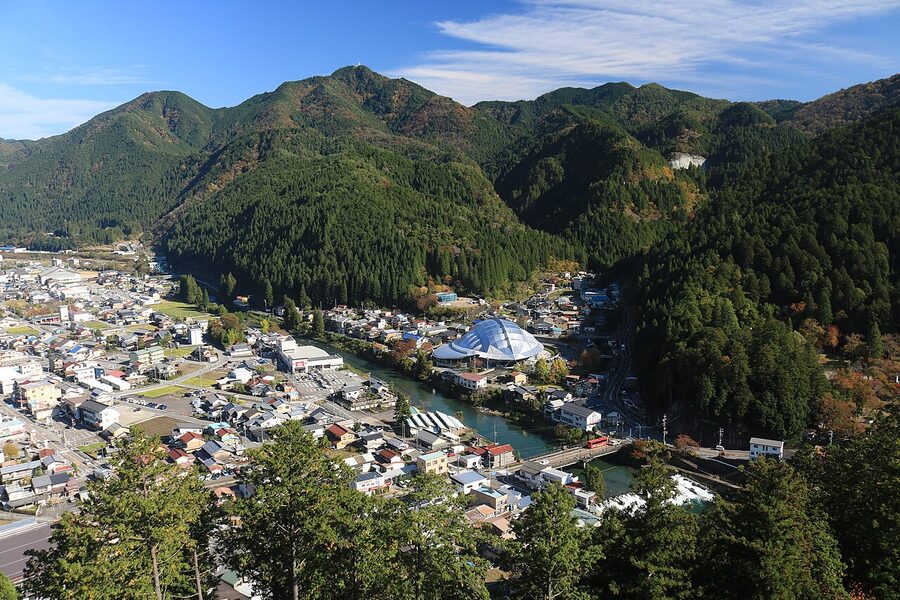
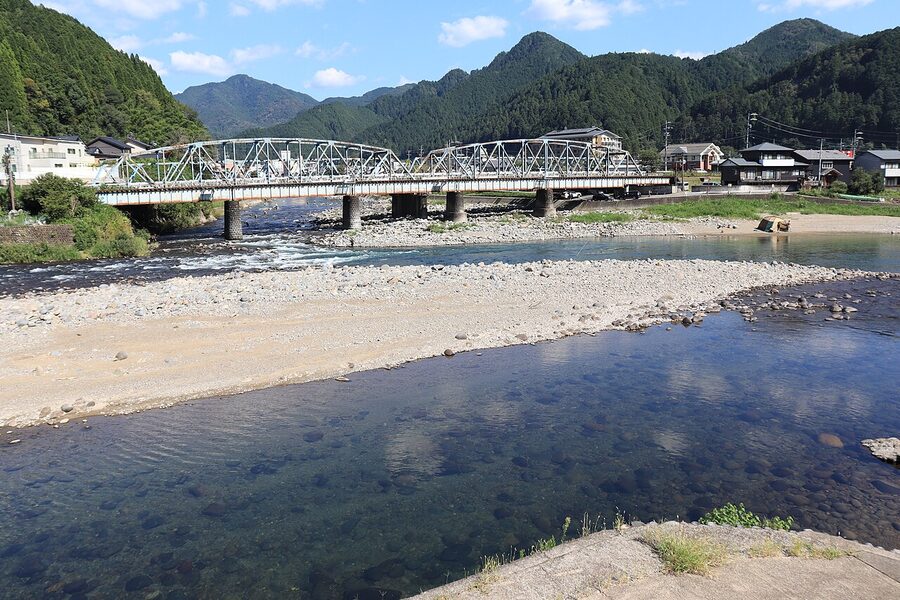
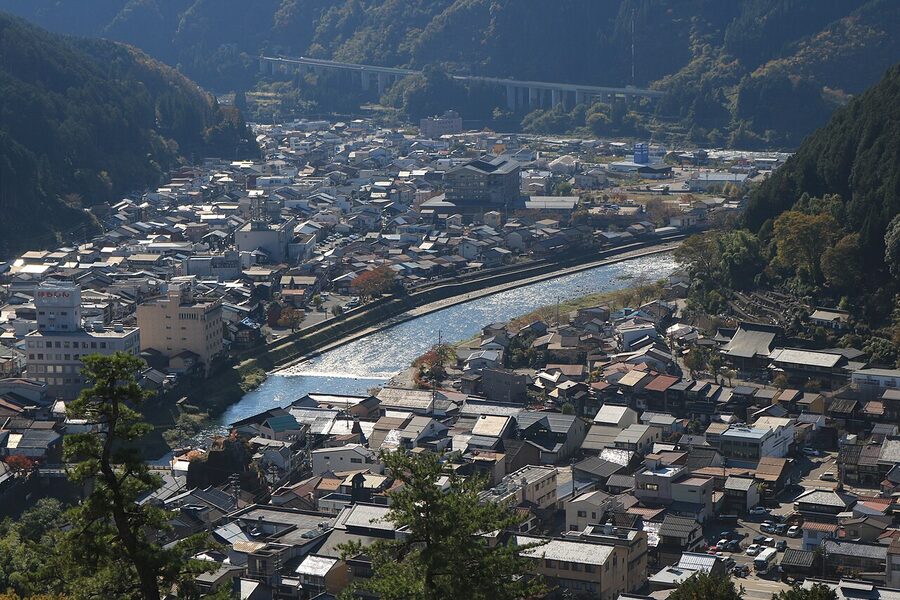
The town sits in central Gifu Prefecture at the confluence of the Yoshida River and the Nagara River, about 60 kilometres south of Takayama and 75 kilometres north of Nagoya. The mountains close in on three sides. The Tokai-Hokuriku Expressway runs straight past the town, which is the reason coach travel from both Nagoya and Takayama is the fastest option: under 90 minutes either way.
From Nagoya
The Gifu Bus highway coach from the Meitetsu Bus Center runs roughly hourly through the day. Travel time is around 80 minutes and the fare is ¥2,260 one way, ¥4,100 return. Crucially the bus drops you at Jokamachi Plaza in the centre of the old town, not at the awkward Gujo Hachiman IC stop on the expressway interchange. Confirm the destination on the timetable before you board: some services are listed as terminating at the IC. Booking on the official Gifu Bus site before you go costs the same and locks in a seat through Obon week, which fills up fast.
From Takayama
Two daily Nohi Bus services run direct down the same expressway, taking around 75 minutes for ¥1,850. The catch is the schedule: usually one morning departure and one afternoon, and the timetable contracts to one a day in winter. Confirm before you commit. If those don’t fit, take a coach Takayama→Nagoya then change at Meitetsu Bus Center for a Gujo coach, which is slow but always works. Reading the Takayama-from-Tokyo route guide first will tell you whether to base yourself in Takayama or Nagoya for the wider trip.
The slow scenic option: Nagaragawa Railway
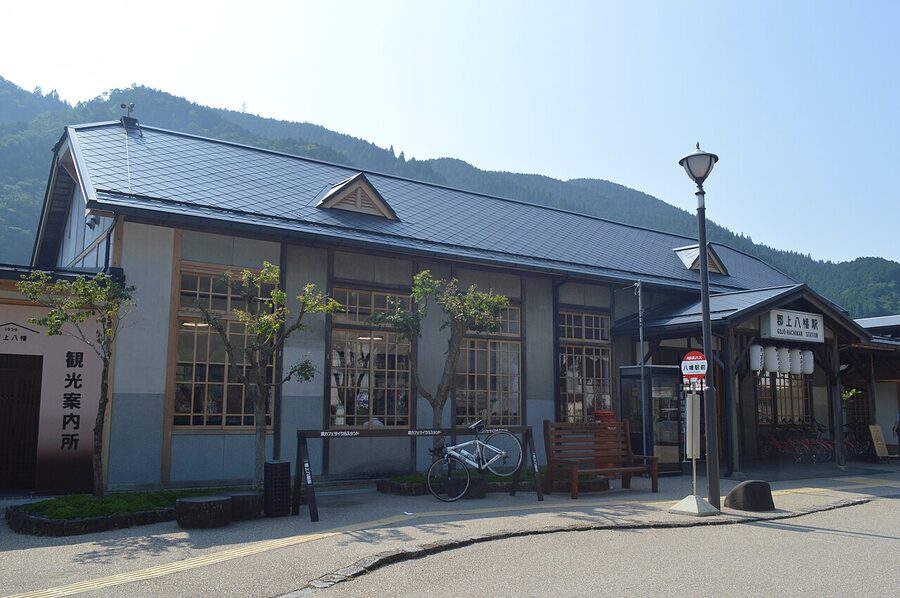
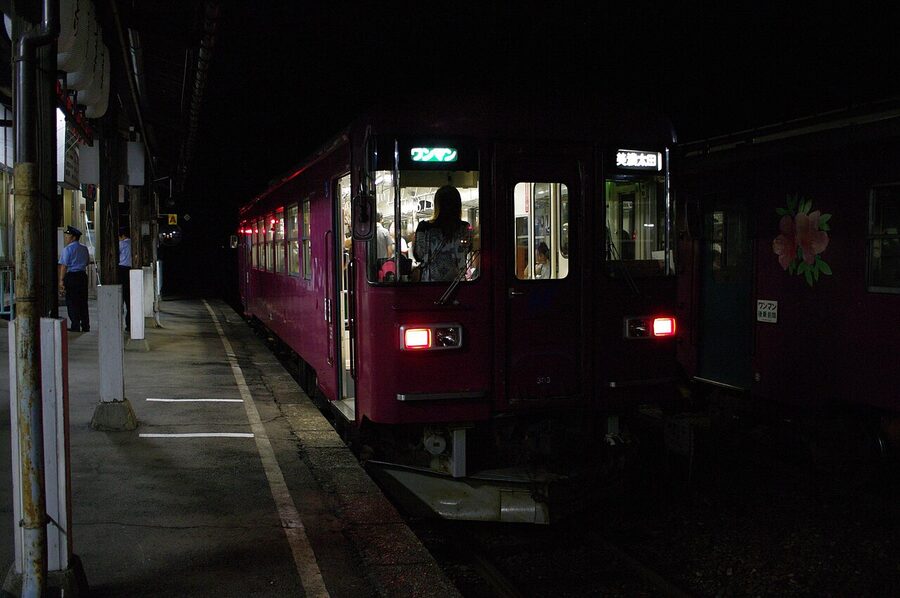
The Nagaragawa Tetsudo line follows the Nagara River for 73 kilometres from Mino-Ota up to Hokuno, with Gujo Hachiman roughly halfway along. From Nagoya the routing is JR Hida limited express to Mino-Ota (around 50 minutes, ¥1,830 unreserved), then a change to the local Nagaragawa Railway up to Gujo Hachiman Station (around 80 minutes, ¥1,420). Total time around 2½ hours, total cost around ¥3,300, which is meaningfully more than the bus on both counts.
Worth it for the river views, particularly the section between Mino-Shi and Gujo where the road drops away and the train follows a green-water gorge that you cannot see from anywhere else. The line also runs an observation-car sightseeing service called Nagara on weekends and holidays, which costs around ¥1,500 extra and adds a meal car. Reserve well in advance for autumn weekends. One downside the bus does not have: Gujo Hachiman Station sits about a kilometre downhill from the central old town, so you walk 15 minutes through a residential area to get to the canals. The bus drops you in the middle.
By car
If you’re already driving the Tokai-Hokuriku Expressway, Gujo is the simplest stop on the route. Exit at Gujo Hachiman IC, drive five minutes down into the old town, park at one of the marked lots near the Kyu-Chosha Kinenkan (the old town hall, now a tourism office: ¥500 for the day, 32 spaces). Street parking is not permitted in the historic district. Combining Gujo with Shirakawa-go on the same expressway day is realistic but tight; allow a full long day for both, leave Nagoya by 08:00, and accept that one of the two will get the short visit.
The Gujo Odori, and how to actually dance it
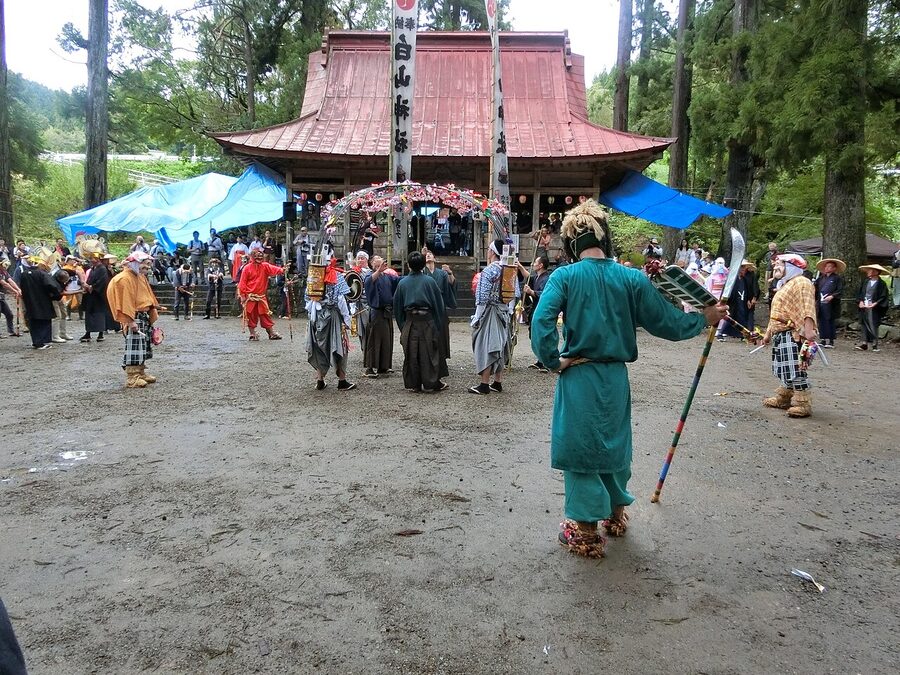
The festival runs across 32 nights between mid-July and early September. Locals will tell you the entire summer in town smells faintly of ageing tatami, summer rain and the wax that holds the geta on. UNESCO added the broader category of Japanese furyu-odori ritual dance to its Intangible Cultural Heritage list in 2022, and Gujo Odori is one of the headline entries inside that listing. It draws over 300,000 people across the full season.
The four nights that matter most: Tetsuya Odori
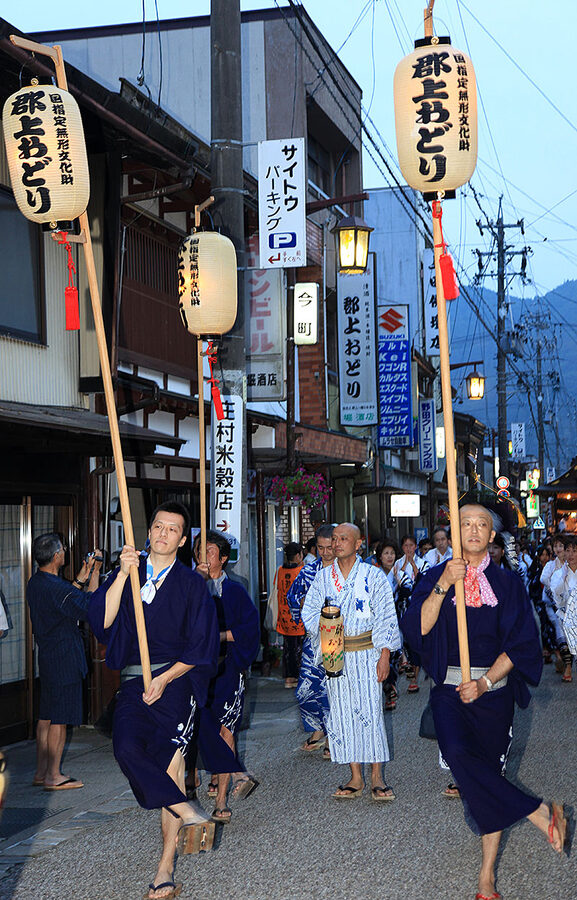
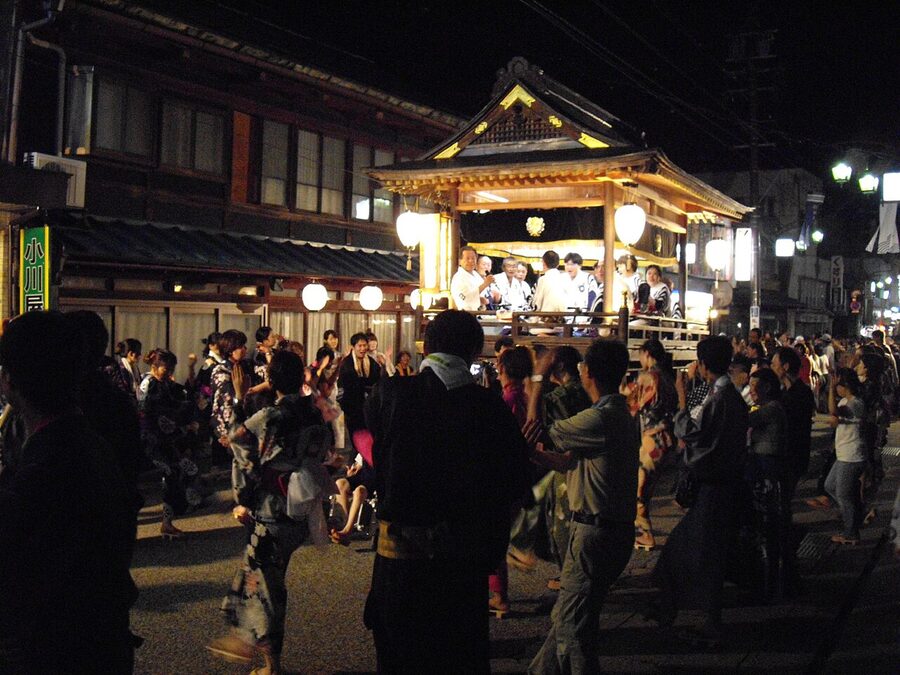
The headline event is four consecutive all-night sessions on 13, 14, 15 and 16 August, the days of obon in central Japan. Dancing begins at 20:00 and continues until 05:00 the following morning, with brief breaks roughly every two hours. The yagura tower in the centre of the dance floor is rebuilt at the start of every season and dismantled at the end. Singers and shamisen players take shifts on top of it; the songs cycle through the ten named dances on a fixed sequence so anyone in the circle knows what’s coming next.
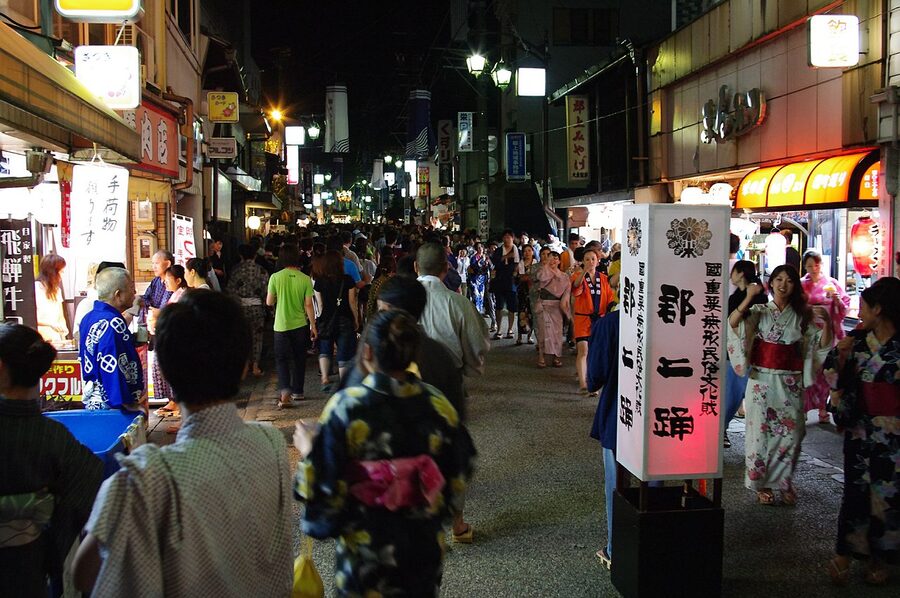
The four nights are also the busiest. The town’s regular population is around 13,000; on the central Tetsuya nights it triples or quadruples. Hotels and ryokan in town book out by April for August. Day-trip viewers from Nagoya tend to arrive around 22:00, watch for an hour and leave on the last bus around midnight; they miss the most atmospheric part, which is the slow shift between roughly 02:00 and 04:00 when the casual visitors are gone and the dance contracts to a tighter, older, more confident core. If you can stay in town and last to 04:00, do.
The ten dances
There is no single Gujo Odori. The festival cycles through ten distinct dances, each with its own song, footwork pattern and clap sequence:
- Kawasaki: the gateway dance, the easiest to pick up, the one you’ll see first when you arrive. Most outsiders learn this one in five minutes from the people in front of them.
- Harukoma: the second-easiest, faster tempo, with a distinctive horse-trotting hand movement that gives the dance its name (literally “spring colt”).
- Sanbyaku: a comic dance with exaggerated postures.
- Yatcha: more demanding footwork; usually appears later in the night when the casual crowd has thinned.
- Jinku, Sageyama, Genkenmitsu, Kasamatsu, Matsuzaka, Neko-no-ko: the remaining six, each tied to a specific song and rhythm.
You do not need to learn all ten. Almost everyone in the circle, locals included, sits some out and only joins the ones they’re confident in. The Hakurankan museum (more on it below) runs a daily one-hour demo session through the year that walks you through the basic steps of Kawasaki and Harukoma. If you’re going to the actual festival, drop in to the morning session beforehand. You’ll feel less ridiculous in the circle.
What to wear and what to bring
The most-asked question. Yes, dance in whatever you have on. The festival’s defining principle, dating back to the Edo period, is that everyone dances together regardless of class or background. Yukata are common in summer because they’re cool, not because they’re required. If you’re staying overnight, your ryokan will lend you a yukata; ask at check-in.
The footwear matters more than the clothing. Most dancers wear geta, the wooden clogs, and the rhythmic kara, kara of geta on asphalt is half the sound of the dance. They also produce blisters within an hour if you’ve never worn them. Buy a pair from one of the geta shops on Shinmachi (around ¥3,000–6,000 for a basic pair) but break them in before the festival starts. If you are walking up to the dance from a long day of sightseeing, bring a small towel: even at 22:00 in August it’s hot, sweaty work, and the local dancers all carry one slung through the obi sash.
The Hakurankan museum, year-round
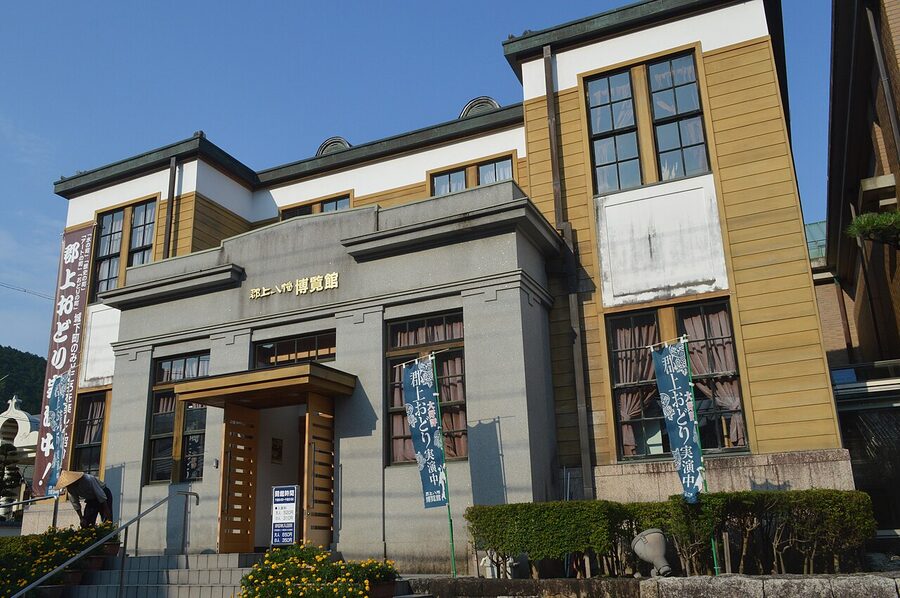
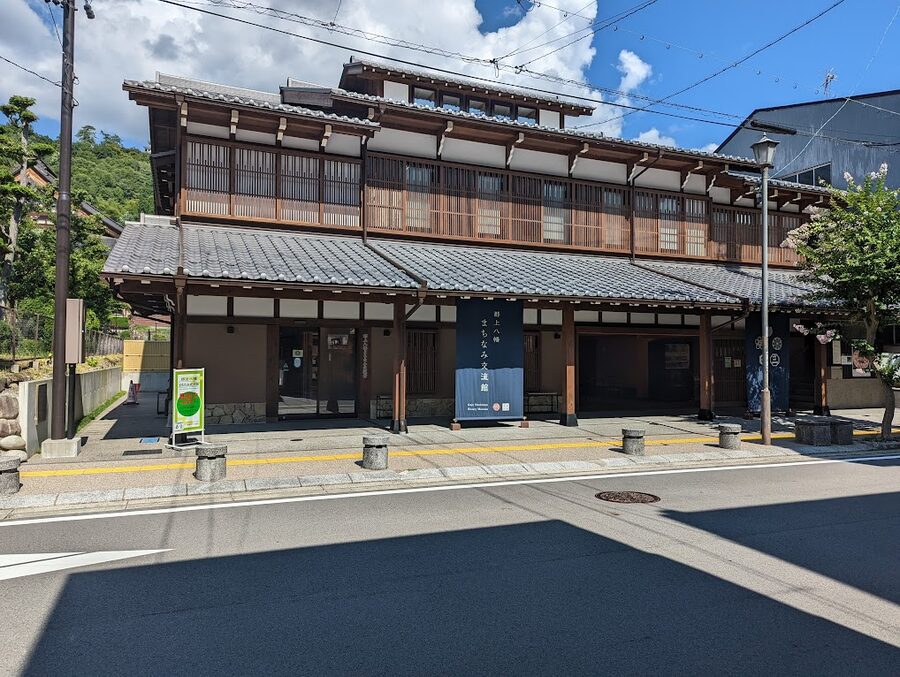
If you cannot make the summer dance, the Gujo Hachiman Hakurankan museum on Hakubacho-mae street runs a daily live demonstration of three or four of the dances, with audience participation. The demonstration sessions run roughly every 90 minutes between 10:30 and 16:00. Entry is ¥540 adults, free for primary-school children. The museum also holds the most thorough explanation of the festival’s history and its 17th-century origins, told mostly in Japanese with limited English signage.
Hachiman Castle, the oldest wooden reconstruction in Japan
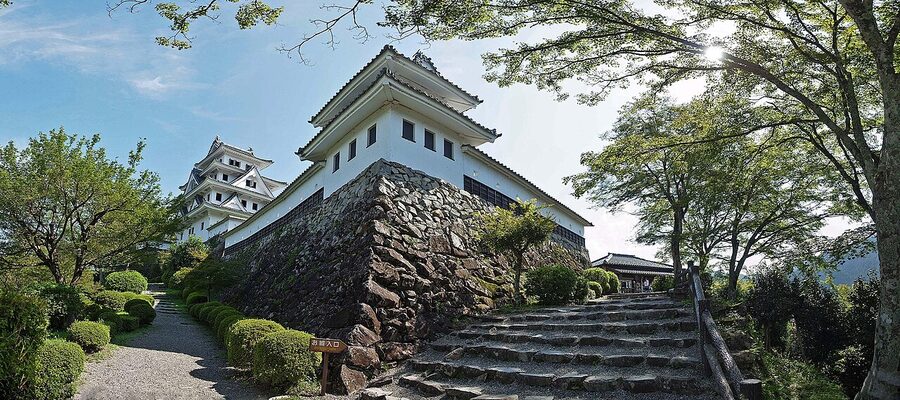
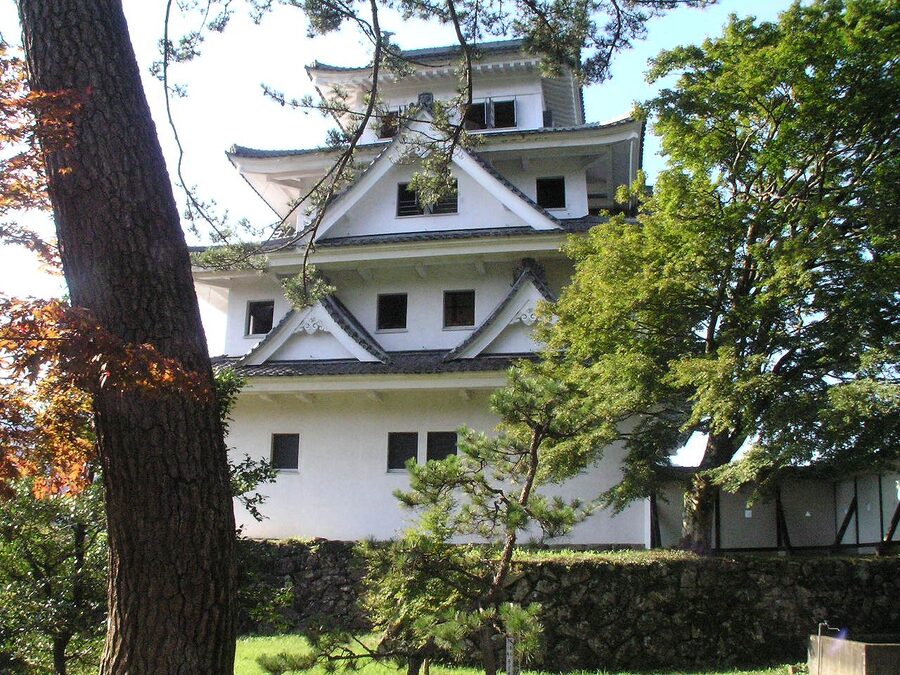
The original castle was built in 1559 by the Endo clan and demolished in 1870 during the early Meiji-era nationwide castle clearance. What stands today is a 1933 wooden reconstruction commissioned by the town to mark a major anniversary, and it is the oldest such reconstruction in the country. That detail matters: most of Japan’s “castles” today are 1960s ferro-concrete museums dressed up to look like castles. Gujo Hachiman’s keep is a working timber building, creaks and all, and the floorboards talk back to you as you climb.
Getting up there
The castle sits on a 350-metre ridge above the old town. Two ways up:
- On foot from the river: a steep, switchback footpath that starts behind the Yamauchi Ippei statue near the river. Allow 25–35 minutes climbing. The path is paved but slippery in rain and largely unshaded, which matters in August. There are wooden benches every few hundred metres.
- By road, then a short walk: a narrow paved road switchbacks up the mountain to a small car park near the keep (free, around 50 spaces, fills early in autumn). From the car park to the entrance is a five-minute uphill walk. If you’ve hired a car, this is the easy option.
There is no bus or shuttle. A taxi from the central old town to the upper car park costs around ¥1,500 one way and is the right call if you have mobility issues, are travelling with children under 8, or are visiting in mid-summer when the climb is genuinely brutal.
What’s inside
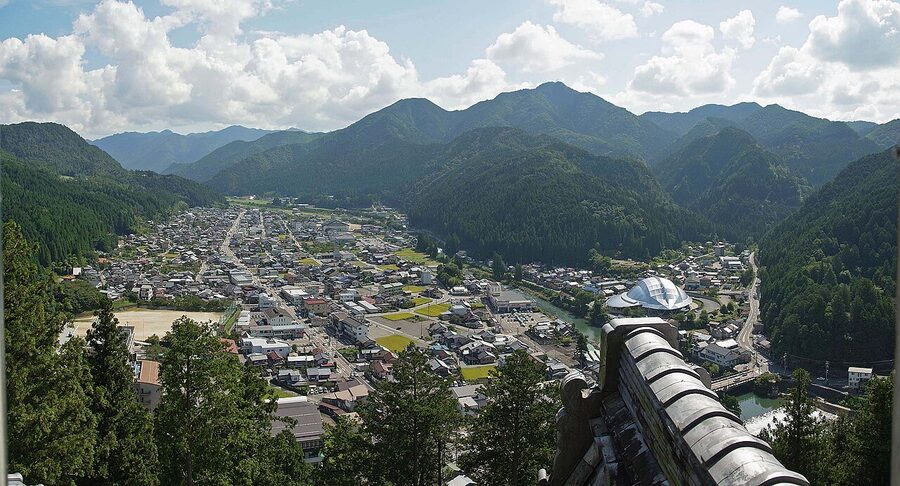
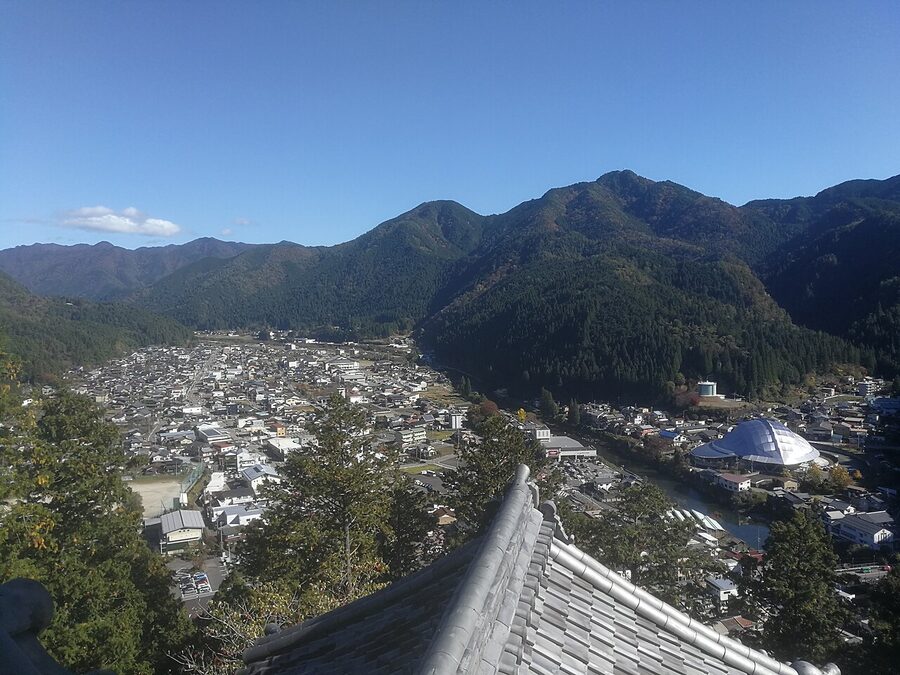
Entry is ¥320 for adults, ¥150 for children. Open 09:00–17:00 (16:30 last entry) March through May and September through October, 09:00–18:00 in June through August, and 09:00–16:30 November through February. Closed 20 December–10 January for winter maintenance. The four-storey interior has a small museum on the first two floors with samurai armour, scrolls, and a recurring exhibit on the legend of Oyoshi no Monogatari, the local human-pillar story said to surround the original construction. The third and fourth floors are observation, with a 360-degree view down the Yoshida valley and across to the seven temples scattered through the lower town.
When the castle “floats”
The castle-in-the-sky photograph that sells the place to autumn visitors needs specific conditions: clear cold mornings between 25 October and 20 November, after a damp evening, viewed from the Shiroyama Park observation point on the next ridge across the valley (about a 45-minute drive from the centre, signposted as Shiroyama Tenboudai). Arrive before sunrise. The fog usually burns off by 08:30. There is no public transport to the viewpoint, so this is a hire-car or taxi-from-Gujo (around ¥3,000 one way) trick. Worth it on the right morning. A waste of time on the wrong one.
The water town: koi in the drainage ditches, springs you can drink
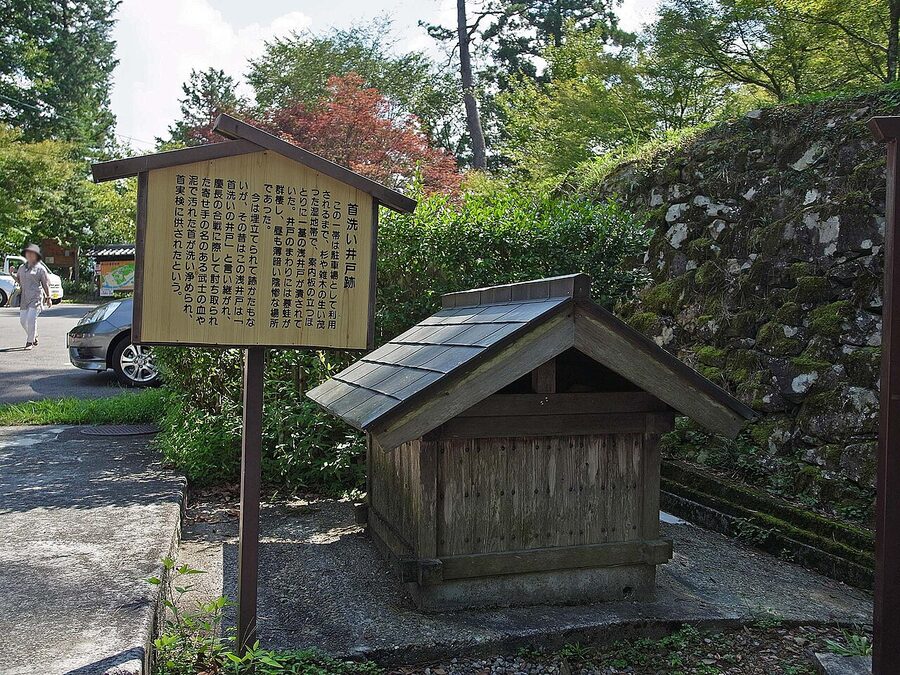
Gujo Hachiman sits on hard rock at the join of two rivers. The local geology produces consistent cold spring-water year-round, and the town has built around it for four centuries. The historic district has a continuous network of stone-lined channels carrying water through every street. Every house was originally connected: drinking water from one channel, washing water from another, and the channels still function the same way today. Townspeople take turns clearing them.
Igawa Komichi (Igawa Lane)
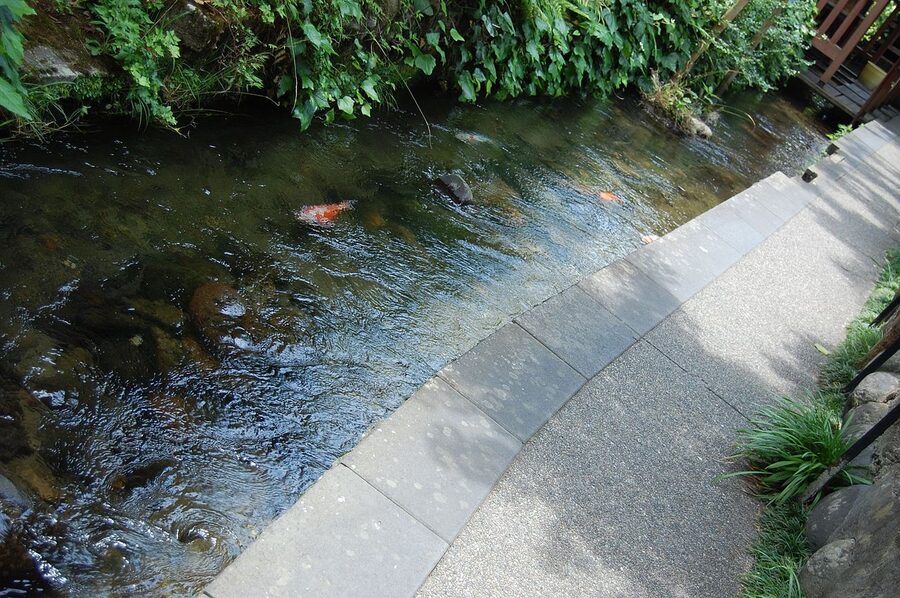
The 119-metre walking lane behind Hachiman Shrine is the postcard. A narrow stone-paved path runs alongside a spring-fed channel about a metre wide, with old machiya houses on one side and a hedge on the other. The koi are large enough that you can hear them when they splash. Buying fish food works on the local honesty system: a small wooden box at the entrance to the lane holds packets of pellets; drop ¥100 into the slot, take a packet. The koi will follow you the length of the lane.
Best photographs are early morning before the day-trippers arrive (the lane is empty by 07:00 and busy from 10:30) or after dark when the lampposts come on. Avoid peak holiday hours in October. The lane is narrow enough that 15 people on it feels crowded.
Sogi-sui, the spring with a name
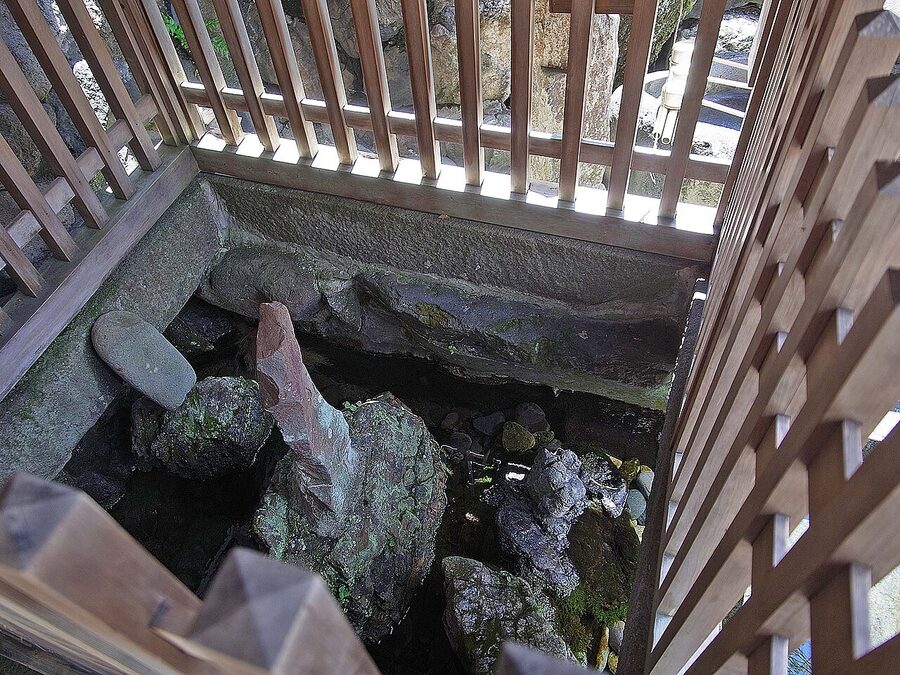
Inside an alleyway off Yanagi-machi, opposite a 600-year-old willow tree, a small four-tier stone trough catches the source of one of the town’s main spring channels. This is Sogi-sui. It’s named for the wandering 15th-century renga poet Iio Sogi (1421–1502), who is said to have stopped here on his way to Suo Province and wrote a poem about the water. In 1985 the Environment Agency selected it as one of Japan’s 100 Best Waters, the only spring in central Gifu to make the list.
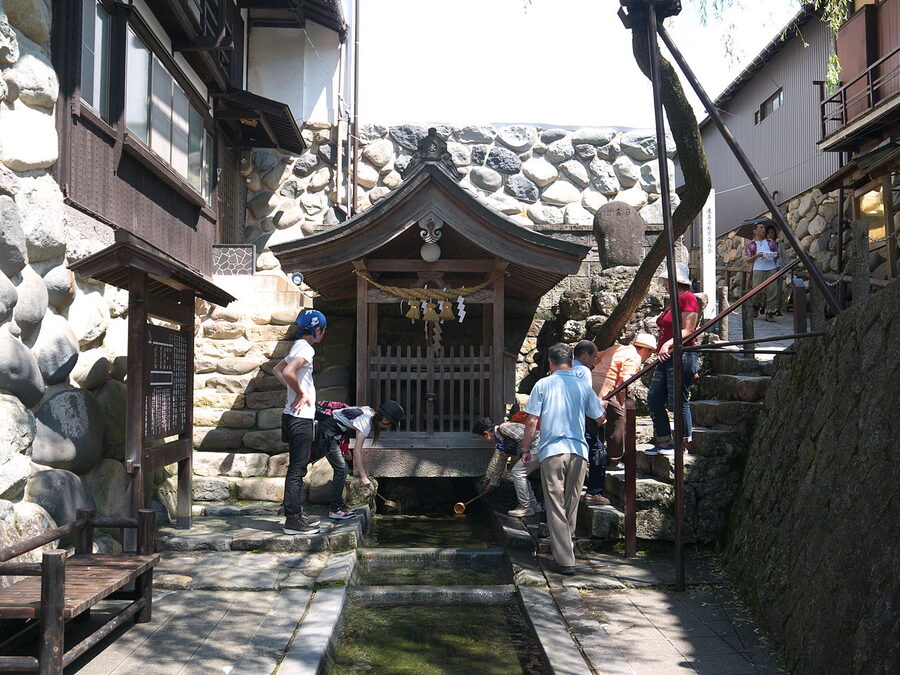
Drink from the cup. The water is sharp, clean, slightly mineral. Don’t fill a bottle to take away unless you have something with a tight seal: it changes flavour fast. There’s a small unmanned guestbook beside the trough where visitors leave notes, mostly in Japanese, going back decades. The spring is open 24 hours, free, no entry restrictions.
Yanaka Mizu no Komichi
A second walking lane, less busy than Igawa, paved with a mosaic of 80,000 hand-laid pebbles arranged in a flowing-water pattern. The 8 in the rock count is deliberate: Hachi in Hachiman means eight, and the town has a small fascination with multiples of eight. Stones come from the Nagara and Yoshida riverbeds. The lane is short, maybe 40 metres, and easy to miss if you’re not watching for it.
The Yoshida River and the bridge-jumping kids
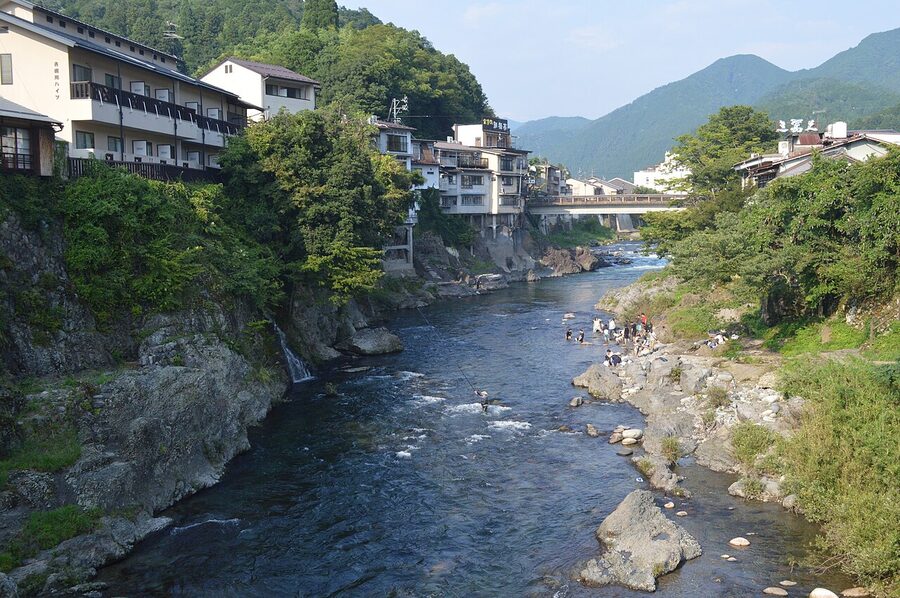
The Yoshida runs through the town from east to west, joining the larger Nagara just downstream. In summer, local children jump from the Shinbashi (New Bridge) and Miyagase Bridge into the river below, a tradition that goes back at least to the 1950s and is still tolerated by the town authorities even though it would be illegal almost anywhere else in Japan. The drop from Shinbashi is around 12 metres into a deep pool. Do not copy them. The water depth varies with rainfall, the locals know exactly which spot to aim for, and the river bottom has hidden rocks. Watching is fine. Jumping is not for visitors.
Plastic food: where Japan’s restaurant samples are made
Walk past any restaurant in any Japanese city and you’ll see them in the window: improbably realistic ramen, parfaits with droplets frozen mid-fall, tempura held aloft on chopsticks. They’re called shokuhin sampuru, food samples, and roughly half of every plastic noodle bowl in the country is moulded in Gujo Hachiman. The industry started here in the 1930s when a craftsman named Iwasaki Takizo, working from a hot-spring resort up the road, developed a wax-based moulding process and refined it into something good enough to fool a passing tourist. His company, now Iwasaki Mokei, still operates from the south side of town, and visitors can drop in to make their own.
Sample Kobo (Sample Workshop)
The smaller of the two visitor workshops, in a 150-year-old machiya house on Hashimoto-cho near the Yoshida River. Most workshops are walk-in and take 20–30 minutes. The popular menus include the spilled-milk smartphone stand (you tip melted plastic from a bottle onto a sheet, watch it solidify into a perfect arrested-motion liquid pour, and stick a “crust” support behind it: ¥1,800), the wax tempura set (¥1,650 for three pieces and lettuce), and the parfait melt (¥2,200). Open 10:00–17:00, closed New Year holidays only. No reservation needed for the basic menus on weekdays; book ahead for weekends and through August.
Sample Village Iwasaki
The larger and more ambitious workshop, run by Iwasaki Mokei (the company Iwasaki Takizo founded), located on Jonan-cho about a five-minute walk south of the central old town. Around ten experience menus, graded easy / medium / hard. The advanced sushi-piece course takes 60 minutes and requires real concentration with the wax temperature control. The kid-friendly tempura course takes 30 minutes and almost always succeeds. Open 10:00–16:00 with last experience starting at 15:00; closed Tuesdays plus the first Thursday in October and first Saturday in February. Reservation recommended; the website handles it in Japanese, the front-desk handles it in basic English. Entry to view the showroom only is free.
If you have time for only one, pick Sample Kobo for spontaneous walk-in convenience, Sample Village Iwasaki for serious instruction. The shopfronts of both sell finished pieces if you want a souvenir without the workshop time: a realistic ramen-bowl magnet runs around ¥2,000, a finished tempura piece around ¥3,500.
The merchant streets and the temples
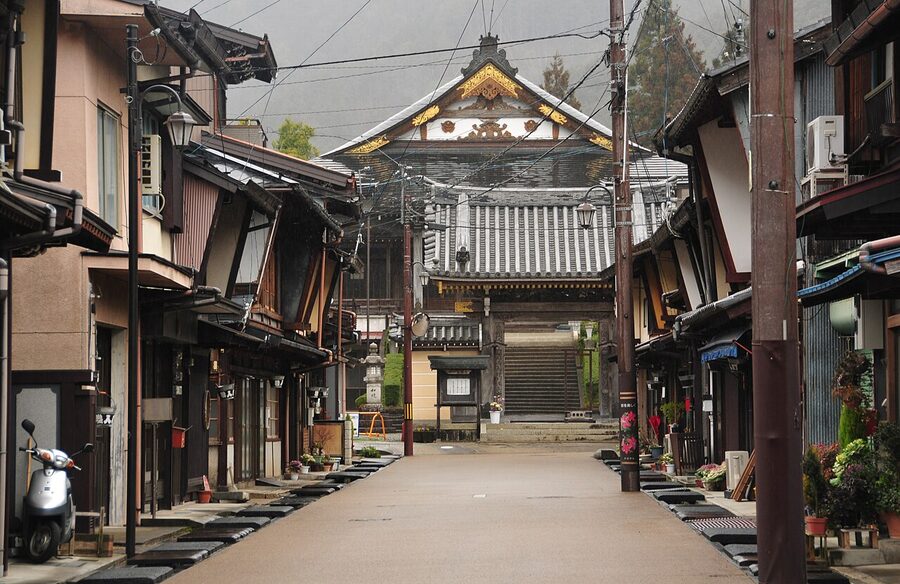
Three of the old streets, Shokunin-machi (Craftsmen’s Street), Kajiya-machi (Blacksmith Street) and Yanagi-machi (Willow Street), are designated as a Nationally Important Preservation District. The wooden shopfronts, the dark grey tile roofs, the eaves that step out over the canals. Most are still occupied by working businesses (lacquer shop, kimono dyer, geta maker, a tofu shop that’s been at the same address since 1860).
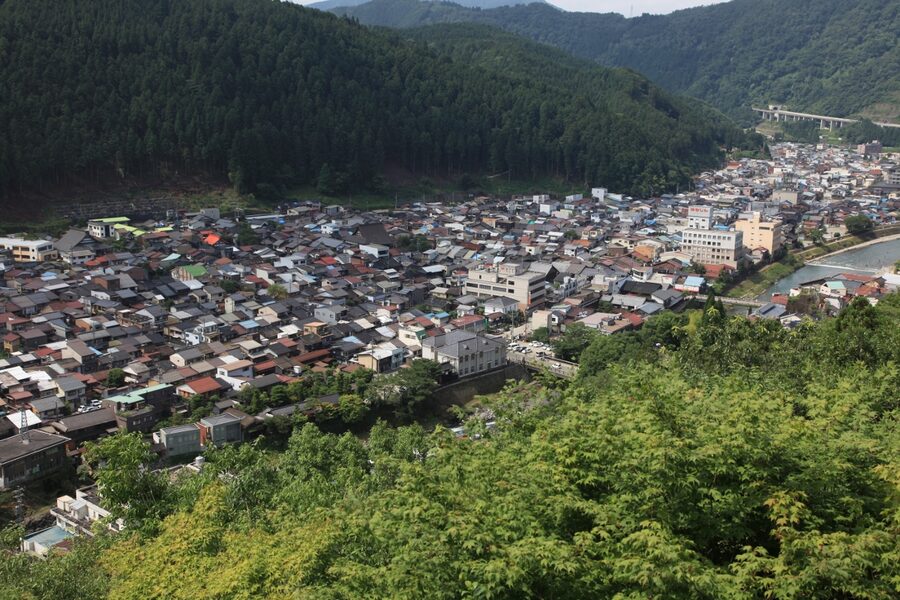
For comparison with the bigger preserved-town circuit you may already know, the closest in feel is Sanmachi-suji in Takayama old town, but quieter, smaller, and with running water everywhere. The streets are uphill enough from the river that the canals run audibly through every block.
The 13 temples
Gujo Hachiman has 13 working Buddhist temples in a town that fits inside one square kilometre. Most are unmarked from outside the old town, tucked behind walls in the middle blocks. The two worth the detour:
Jionzenji. Built in 1606 by Endo Yoshitaka, the second lord of Hachiman Castle, as the family temple. The garden, called Tetsuso-en, is a two-tiered moss arrangement that reads as a scaled-down version of the larger Zen gardens in Kyoto. The temple was largely destroyed by a 1950 landslide and rebuilt; framed photographs in the entrance show the original 17th-century buildings before the slide. Open 09:00–17:00 daily except Tuesdays and 30 December–4 January. Entry ¥500. Sit on the tatami for a while. The garden rewards stillness.
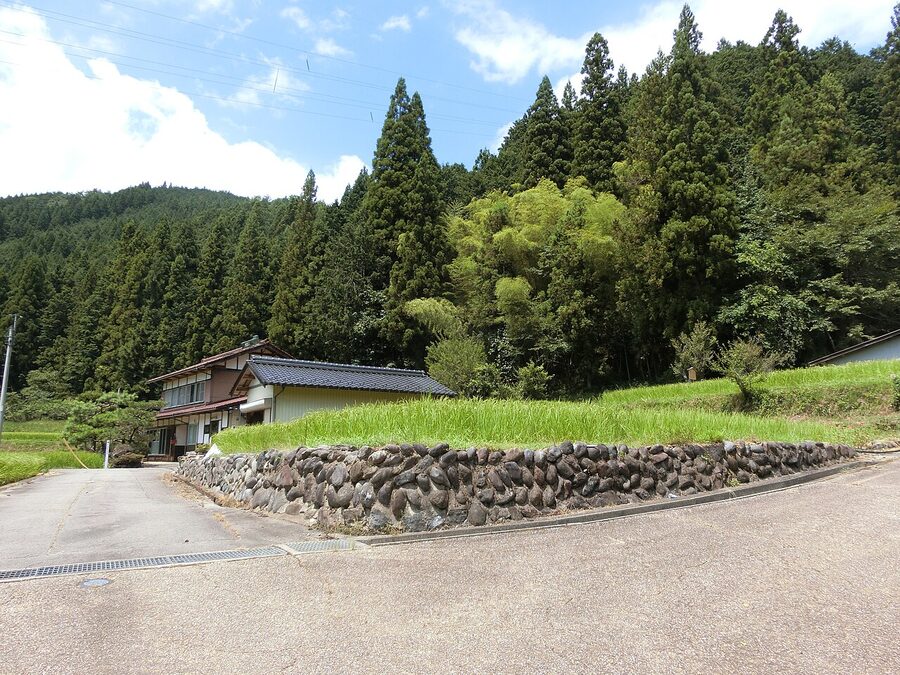
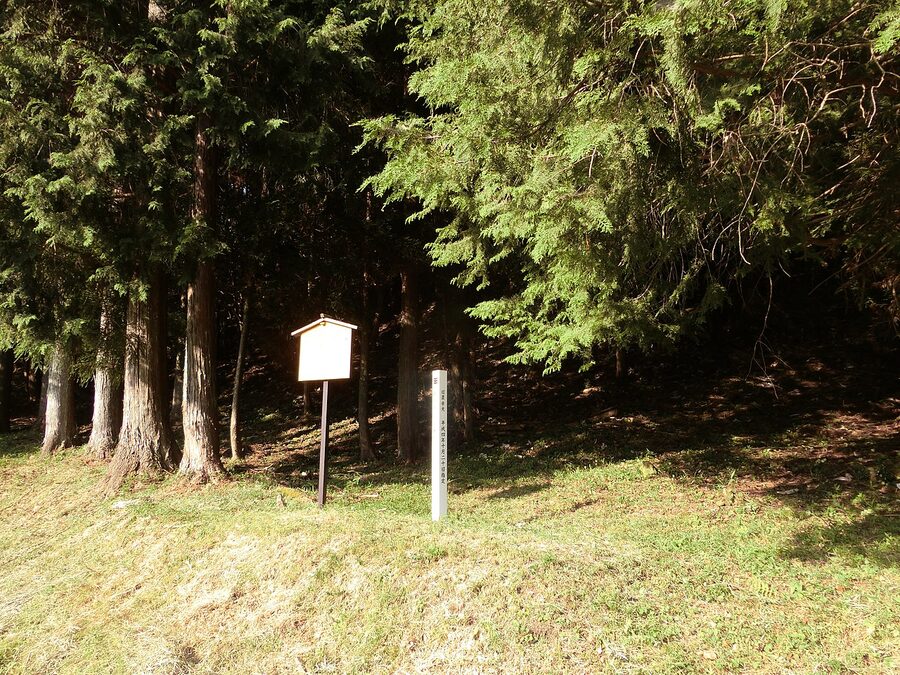
Anyo-ji. Smaller, older, with a famous weeping cherry that flowers around 8–15 April most years. Free, open dawn to dusk. If you’re in town that week, walk through the temple grounds at sunset; the cherry frames the canal behind it.
The shrines
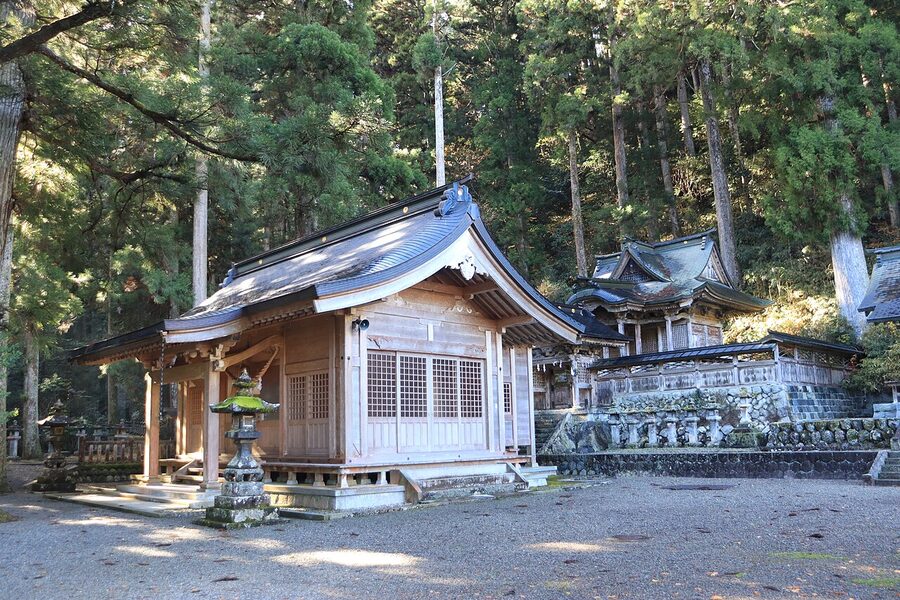
The town’s main Shinto shrine is Hachiman-jinja, on the same site since the 9th century and dedicated to the warrior deity Hachiman. The current buildings are 19th century. The Gujo Odori opening ceremony every July begins here. Out in the residential streets above town, smaller shrines like Hoshinomiya are essentially neighbourhood shrines that locals visit weekly. Pleasant places to walk through if you’re already heading uphill toward the castle.
Where to eat
Gujo’s food is mountain-river food, plus the local specialities that come with castle-town money: ayu (sweetfish from the Nagara), Hida-region beef from just up the road, regional buckwheat soba, and the distinctive yellow Okumino curry made with local miso and apple.
Bistro Mu
A small sit-down place on Shinmachi street that does a roughly 80-year-old version of yoshoku (Western-influenced Japanese cuisine), with a hayashi-rice and an omurice that locals queue for at lunchtime. Lunch sets ¥1,100–1,800. Closed Wednesdays. Cash only.
Soba Hirajin
Hand-cut soba, made each morning, located behind Hachiman Shrine in a converted machiya. Cold zaru soba ¥850, hot tempura soba ¥1,400. Open lunch only, 11:00–14:30 (or until they sell out, which is often by 13:30 on weekends). Closed Tuesdays. Two-table queue is normal.
Shinbashitei
The riverside ayu specialist, on the bank just south of Shinbashi bridge. Salt-grilled ayu ¥1,800 for one whole fish, ¥3,200 set including miso soup and rice. Best between June and October when the fish is at its plumpest. Reservation needed for dinner; lunch walk-in usually works. The terrace seats overlook the river and the rope-swing locals use to drop into it.
Cafe Komugi
Roasted-on-site coffee shop on Shokunin-machi. ¥500 for a hand-drip pour-over, hand-cut sandwiches around ¥800. Useful for the 30-minute pause when you’ve walked too much. Wi-Fi works. Closed Mondays.
Okumino curry: a local oddity
You’ll see signs across town for Okumino kare, Okumino-style curry. The defining details: it uses local miso as a base ingredient, includes Gujo-grown apple for sweetness, and is rated by the colour of the rice (it’s served on yellow turmeric rice as a regional certification mark). About 15 restaurants in town serve it. Curry House Otonari on Honcho-dori does a competent version for ¥1,200 with Hida-beef topping for ¥400 extra. Worth trying once if you’re in town long enough.
Food walking, by season
Sweet-stalls along Shinmachi and Honcho-dori change with the seasons. Look for nikkei-tama (cinnamon-glazed sugar balls, a Gujo original) at Sosuke Confectionery year-round; cold ayu-shaped doraneko-yaki (filled pancakes) in summer; freshly steamed sweet-potato wedges in autumn from a stall outside the Kyu-Chosha Kinenkan. Most cost ¥200–500.
Where to stay
The town has around 20 small ryokan and three modern hotels. Most have 6–15 rooms each. Reserve well ahead for August (Tetsuya Odori sells out four to six months in advance), late October (autumn foliage) and early April (cherry blossom). For winter visits January through early March, you can usually book the same week.
Miharaya Ryokan
A small family-run inn on Yanagi-machi, eight rooms, all tatami. Bath is a small in-house onsen using piped hot-spring water from the upper valley. Multi-course Japanese dinner with Hida beef and Nagara ayu is included in the room rate. Around ¥18,000–25,000 per person per night with two meals. Walking distance to the dance floor in summer. Stays available year-round.
Sekisuien
The slightly larger ryokan halfway up the castle road. Modern rooms in a traditional shell. Onsen overlooks the Yoshida valley. Around ¥22,000–30,000 per person per night with two meals. The location is a steep five minutes’ walk from the central old town, which can be either a pro (escape the festival noise after midnight) or a con (your geta will not survive the climb up).
Hotel Gujo Hachiman
The modern Western-style hotel by the bus terminal. Rooms are dated and the building shows its 1980s vintage, but it’s the cheapest option in town and the location is unbeatable. Around ¥6,500–9,500 per person per night room only. Useful if you’re on a budget, or if you’ve booked late and the ryokan are full. Don’t expect a spa.
Camping at Mt Washigatake
About 30 minutes’ drive north of town, the Washigatake area has organised campsites and a public hot spring. Useful base for the dance week if hotels are sold out and you’re driving. Pitch fees from ¥1,500.
Or stay in Takayama
If Gujo is full or you want a wider trip, base yourself in Takayama for the regional cluster. The morning bus from Takayama gets you to Gujo by 09:30, the late afternoon bus brings you back by 18:00. Misses the dance, but works for everything else.
When to visit
Each season fundamentally changes what you do in Gujo. The dance is the obvious peak, but each shoulder period has its own claim.
Spring (mid-March to late May)
Cherry blossom along the Yoshida River around 5–15 April most years; the willow tree at Sogi-sui leafs out in mid-April; new green on the castle ridge from late April. Quiet otherwise. Average temperatures 10–20°C. Bring layers. The Anyo-ji weeping cherry peaks 8–15 April.
Summer (June to early September)
Hot, humid, alive. Dance season. River swimming. Ayu fishing. Carry a small towel and a water bottle. Average daytime temperatures 28–33°C; evenings 22–26°C. The Tetsuya Odori, 13–16 August, is the headline four nights. The whole season runs from the second weekend of July through 8 September.
Autumn (mid-September to late November)
The visual peak. Maples around the castle turn red 5–25 November in most years. The “castle in the sky” fog photographs work this period. Crisp days, cold nights. Daytime 12–20°C, nights 4–10°C. Heaviest weekend crowds of the year on the autumn-foliage Saturdays in mid-November.
Winter (December to mid-March)
Quietest season. Snow on the castle a few times a year (usually January). The town is cold but functional; canals never freeze because of the spring temperature. Most ryokan stay open. Sample workshops are quietest, easiest to book. Average daytime 4–9°C, nights 0 to −5°C. Castle closes 20 December–10 January for winter maintenance; check before you travel.
What to combine Gujo with
The town earns a half-day to a day-and-a-half on its own. Most foreign visitors will combine it with one or two other regional stops, and the geography supports that easily.
Takayama (one hour north on the same expressway)
The natural pairing. Arrive in Takayama by Shinkansen + JR Hida from Tokyo or Nagoya, spend two nights there exploring the morning markets, the Hida Folk Village, the old town, and what is genuinely the region’s best food scene; then take a half-day side trip down to Gujo on the morning Nohi bus, return same evening. Or do it in reverse: night in Gujo for the dance, then north to Takayama. The Tokyo→Takayama route page covers the wider trip planning.
Shirakawa-go (90 minutes north on the same expressway)
The UNESCO gassho-zukuri village of Shirakawa-go sits 90 minutes north of Gujo on the Tokai-Hokuriku Expressway, accessed by a few daily Gifu Bus services through the day. Combining both in one day from Nagoya is realistic but dense: aim for Shirakawa-go in the morning, lunch in Gujo, walking and dance in Gujo afternoon-evening, last bus back to Nagoya around 19:30. With a hire car you can also string them with Hida City further north for a 2-day loop.
Magome and Tsumago (the Nakasendo, 90 minutes south-east)
The preserved post-towns of Magome and Tsumago are the other side of the Hida-Kiso ridge; getting between them and Gujo is awkward by public transport but doable in a car. If you’re already walking the Nakasendo through the Kiso valley, swing through Gujo as a pre or post-walk rest day; the town’s water and quiet make it a good decompression point.
Kanazawa (three hours north-west)
The city of Kanazawa works as the next stop north on a wider Hokuriku trip. Direct buses from Gujo to Kanazawa run twice daily and take around three hours. From Kanazawa you can connect to Tokyo on the Hokuriku Shinkansen.
Nagoya itself
If you’ve based in Nagoya for the day trip, the city itself is worth at least a half-day for Atsuta Shrine, the castle reconstruction, and the underground food scene on Sakae. Practical hub city: the airport (NGO/Centrair) is 30 minutes by Meitetsu rail.
Wider planning
The regional access guide covers the trains and buses that get you in and out of central Honshu; the itineraries page has 5, 7 and 10-day routes that stitch Gujo into the broader Japan Alps cluster. Add Gujo on the Nagoya leg of any of them.
A few small things, in closing
Gujo Hachiman is unusual in central Japan for being entirely uninterested in performing for visitors. The dance happens because the town wants to dance. The water is clean because the neighbours rotate the channel-cleaning duty among themselves. The castle is rebuilt because in 1933 a generation of local people decided their town deserved a castle on its hill.
This makes it a different kind of trip from the more orchestrated heritage towns. There is no audience side of the rope at the festival, because there is no rope. The koi in the drainage ditch are fed by a man who has done it every morning for 30 years. The cup at Sogi-sui hangs there because somebody bought it 40 years ago and nobody has needed to replace it. If you’re the kind of traveller who needs structured experiences, this town will frustrate you. If you’d rather drink from a 600-year-old spring and figure out the geta-clap on Kawasaki by watching the woman in front of you, get the Nagoya bus and stay overnight.


.jpg)
.jpg)
.jpg)


.jpg)


.jpg)
